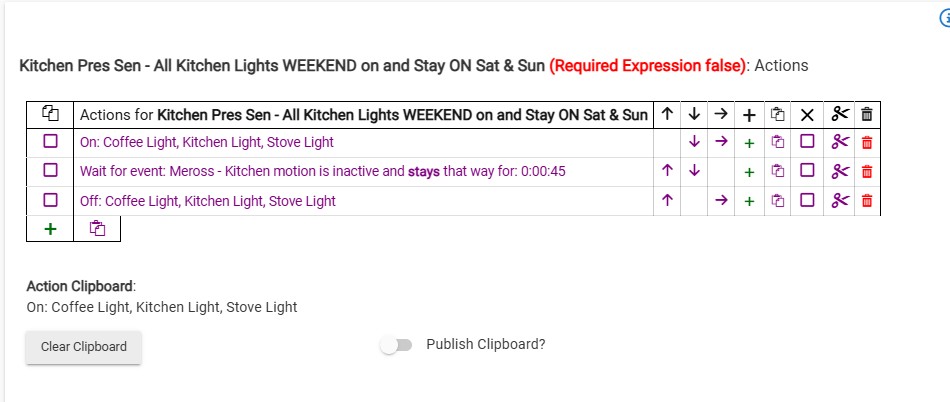
I had MS600 working great in all my rules that had the Meross MS600 in it. Now none of the rules work with it. It triggers the lights on like a motion would but after the wait time expires the lights go off. To me it appears that just the motion part of it is working. And it it the Meross.
In the Meross app you can see activity, after the motion was triggered with my wife in the kitchen for like 15 minutes and it detected her the entire time. So is it the Meross that is functioning properly or is it the Hubitat?
Trouble shooting:
restarted the hub 3 or 4 times
power cycled the the Merosss - several times
made new rules for it.
Sample Rule the team helped me make - and it works GREAT!
I had 4 Meross MS600 Sensors. These were a replacemet for the Linptec because Linptec requires a periodic power cyckle. These MS600 toys worked flowlesly for abouy a year but started to quite one by one. Failing sensors still reported Lux but stopped to report Motion. I was not able to restore Motion reporting. So now all they are trash.
Human Presence Sensor ES1,Smart Motion Sensor with 24G mmWave Radar,Occupancy Sensor Requires Tuya Zigbee Hub for Home Security and Automation,Compatible with Alexa,Smart Life,Z2MQTT,ZHA
And it works with the Hubitat hub? I don't need to buy - Tuya Zigbee Hub
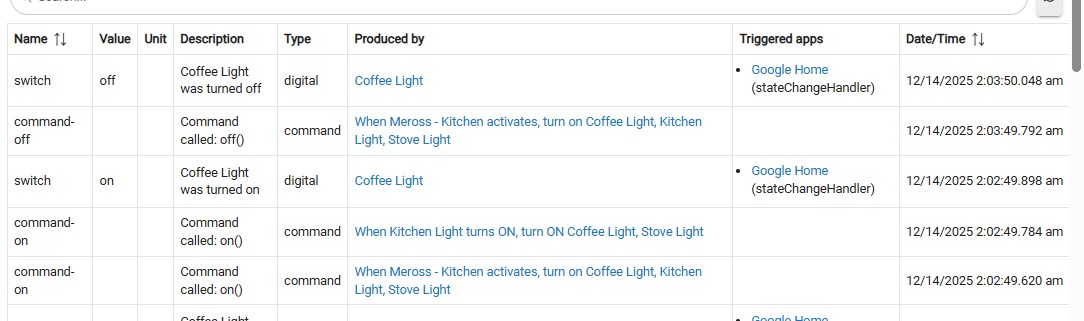
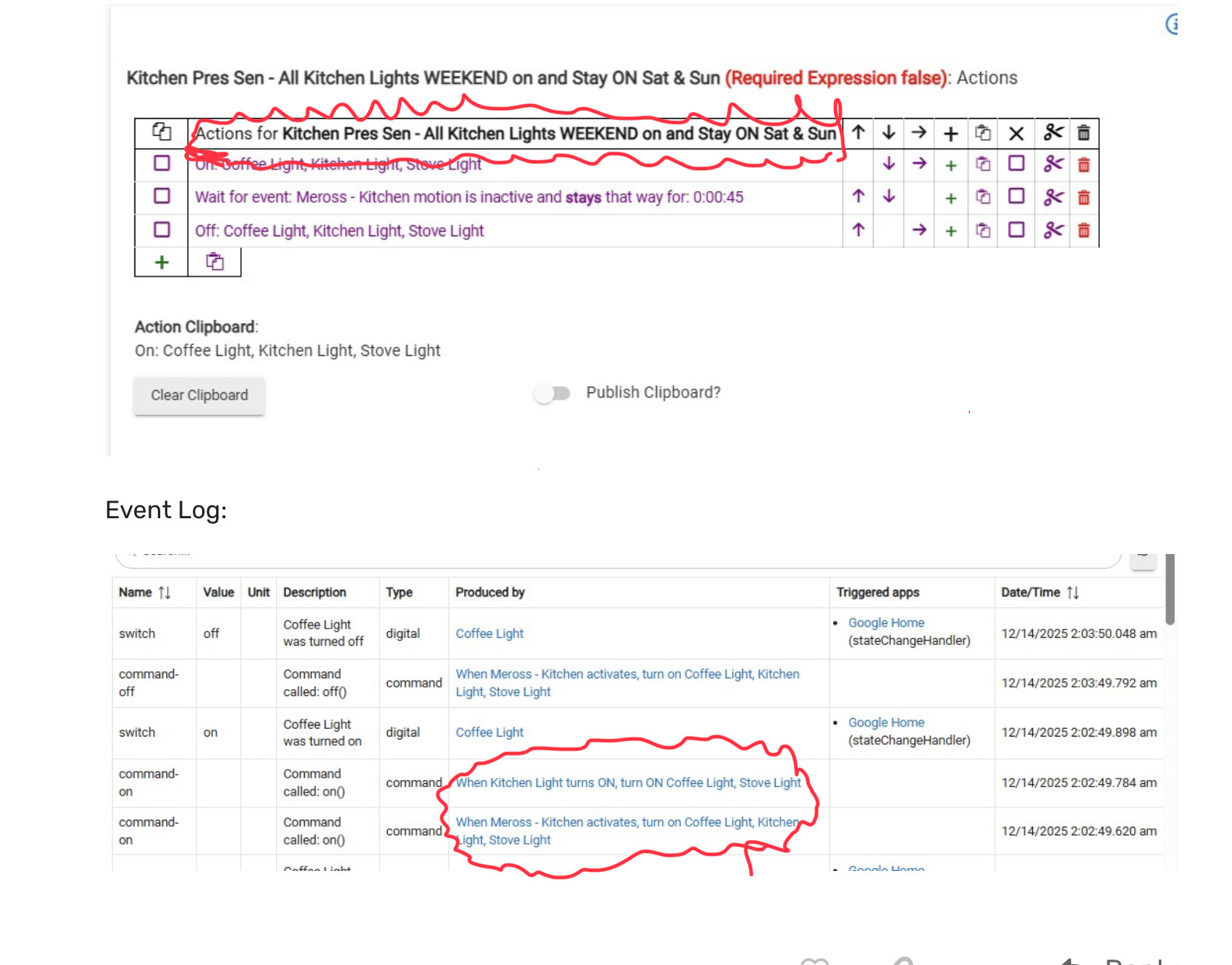
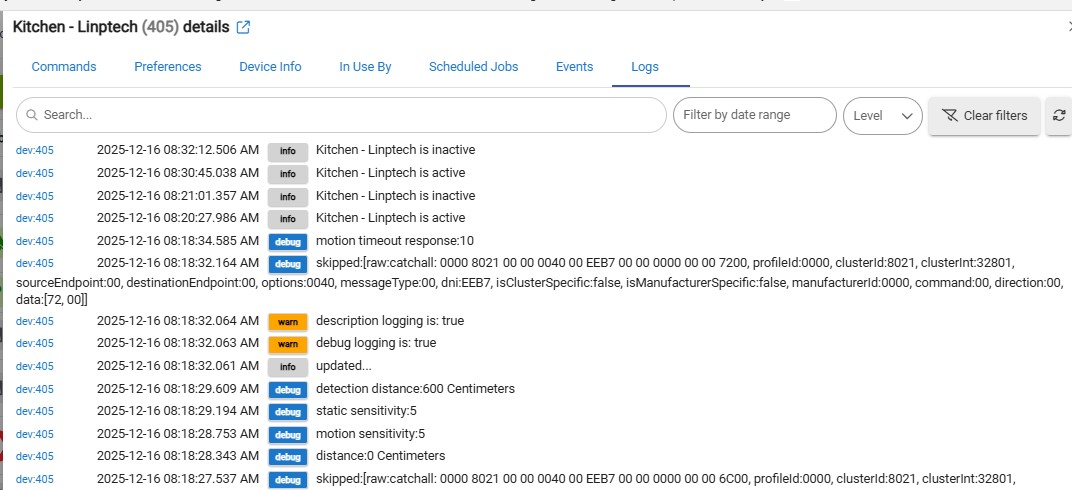
It appears that the logs you are showing are not from the rule that you displayed. Looks like you have another one or two rules which can control the kitchen light, etc..
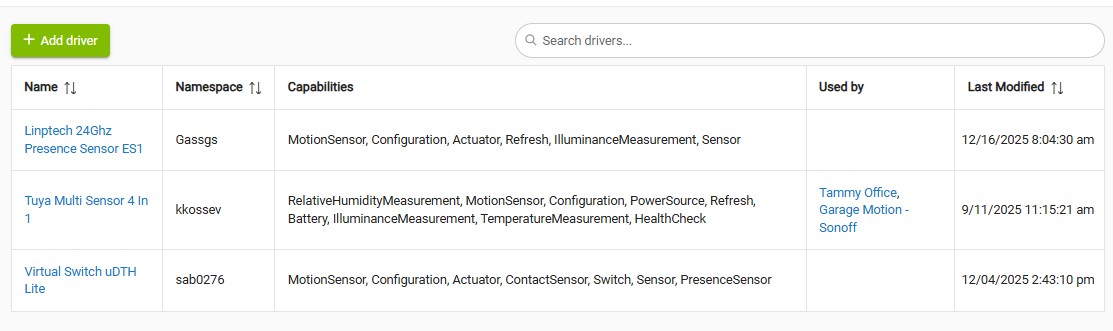
You will want to use this driver, it will also give you illuminance.
I have five of those. There is no rhyme or reason why they need a power cycle. Some will stop responding just with time, and some will not respond after a hub reboot. It is a bit annoying but I've been dealing with it since I like them otherwise.
Some have gone months at a time with no issues, and sometimes they are fine after a reboot. Some will go silent after a few weeks, and some just don't work after reboot.
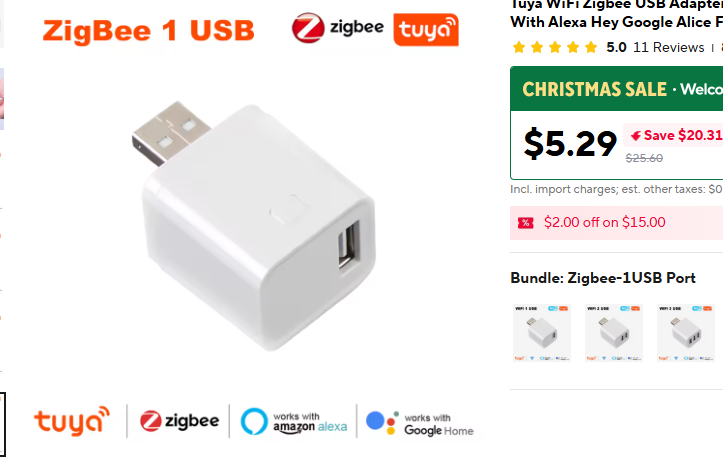
I've been thinking about getting some of these to remote boot them, and have a routine to reset them after a reboot.
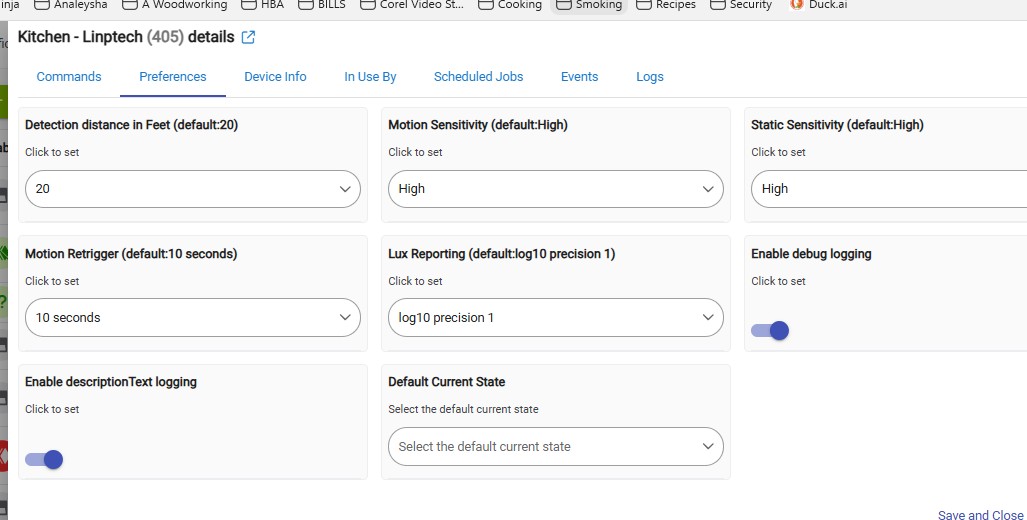
I installed the driver for the Linptech sensor but it still doing the same thing as my Meross MS600. It triggers the lights to come on but they do not stay on. Please tell me what I am missing.
The last screenshot in your post directly above shows a rule that turns the lights off 1' after motion activation -- is that what's actually happening?
If that's the intended action (turn off after 1'), and it's working, then what's the issue?
For all intents & purposes, it actually is a motion sensor... That's the attribute you leverage in rule builds, anyway.
It's unfortunate that mmW devices are marketed as "presence" sensors, since that term (presence) has historically been used across the home-automation industry to describe geofence-related (i.e. home vs away) devices & attributes. And that's how Hubitat (and most, if not all) other HA platforms still use the "presence" attribute.
All mmW sensors (whether they are straight mmW or combo mmW/PIR devices) utilize the "motion" attribute in automations to track motion/presence/occupied or whatever you want to call it.
I’m trying to better understand how the presence sensor is supposed to work.
Previously, I was using a Meross MS600, and for a long time it worked perfectly for my use case. As long as someone was in the kitchen, the lights stayed on. This included situations where a person was standing still or sitting — the lights did not turn off just because there was no obvious movement.
I’m not arguing or saying the current behavior is wrong. I’m simply trying to understand the difference.
My understanding was that a presence sensor does more than detect simple motion, and that it can still detect a person even when they are not actively moving. If that understanding is incorrect, or if this sensor behaves differently, I’d really appreciate some clarification on how it is designed to work.
Sir, I guess the bottom line question here is why are the lights not staying on like the Meross MS600 did when it was working properly? I was told to get the Linptech/Moes Presence sensor because it was better. So I have to believe that I am doing something wrong. Again just trying to get back to where I was with my kitchen lights staying ON for as long as we are in the kitchen.
If the MS600 was working fine, why did you swap it out for the Linptech?
The last rule you posted in this thread turns the lights off 1' after activation -- it does not have any dependency on motion becoming inactive. So if that's the rule you are currently using, that's why the lights are turning off early.
mmW sensors are a relatively new technology and the vast majority of them that you can buy today are still at the level of being cheap-chinese Tuya-based devices.
Meross is a bit more of a name-brand, but even those are still really just Tuya under the hood. Point being, none of these are German-engineered BMWs -- they're all more like low-budget Fiats... Maybe it works as advertised, but maybe not -- like all other AliEx/Tuya stuff, quality control and real-world device performance are going to be wildcards.
Inovelli is now rolling out a mmW switch, and I'd consider them to be the first genuinely legit mainstream player to get in the mmW game. But it's interesting that there still aren't mmW devices from reputable companies like Hue, Aeotec, etc -- given that mmW is a pretty darn lucrative device market, I'm not sure what to make of that, but it does make you wonder...
If the MS600 was working fine, why did you swap it out for the Linptech? Well it worked great for about a month or so and just stopped. Now I just see it working as a motion and since a body in the kitchen. I was told by someone else that he had like 5 of the Meross and had the same problem so replaced them with Linptech.
By the way do you think I should be using RM for the Presence sensor? If so do you have a rule for one that you use and WORKS?
Not to split hairs here, but for the record, he said that he replaced his Linptechs with MS600s, but that he's not using either model anymore.
Whatever rule-engine you use, just treat these like any other motion sensor -- how they'd be leveraged in a rule isn't going to be any different than a PIR sensor -- motion is motion, no matter how it's detected.