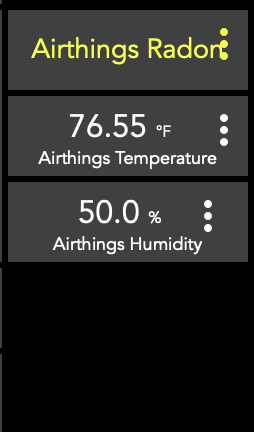
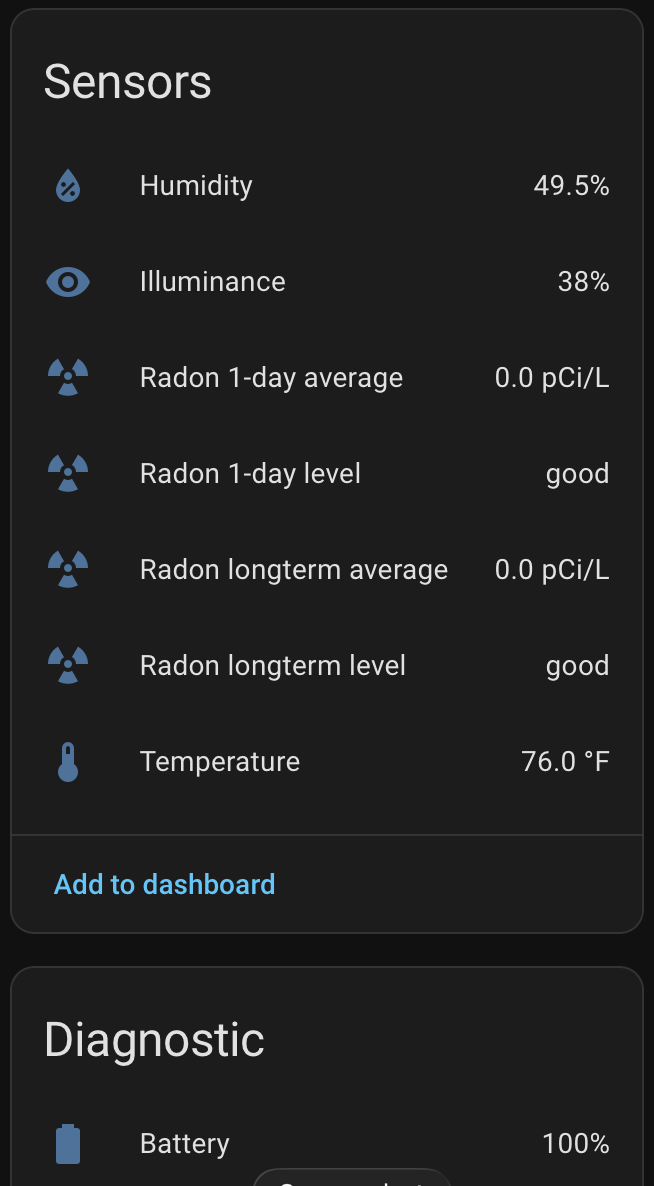
I agree, and I own three AirThings detectors (integrated thanks to @thebearmay ).
I got interested in radon when we decided to set up a bedroom in the basement. We used an Accustar radon test kit which showed the levels were right at the safety threshold. That’s when I bought the AirThings.
The first recommendation was to use ventilation, so I installed an HRV. That cut the average level down by half. So I thought - why submit my child to even that? So we spent $3K on a subfloor pump system and the radon levels in the basement have since been indistinguishable from the main floor (nearly zero).
Most likely as a BLE Proxy/BLE to BTHome convertor, but possibly other direct implementations (haven't found any yet, but it seems to me that ESP32 has some custmonizable options.
The bigger issue here is there are very limited options for radon detection devices. It isn't a sensor you can get easily. Other then the mentioned Airthings devices i don’t know of any other device for smarthomes that detect radon. I looked for a sensor to put into the Air Gradient I have and it wasn't posssible because no sensor existed that could do it. If you find alternative to Airthings please post it here.
We used to call this a temperature inversion back in the day..... where radon was trapped by the thermal layers causing an alarm/alert that is not indicative of the actual average exposure.
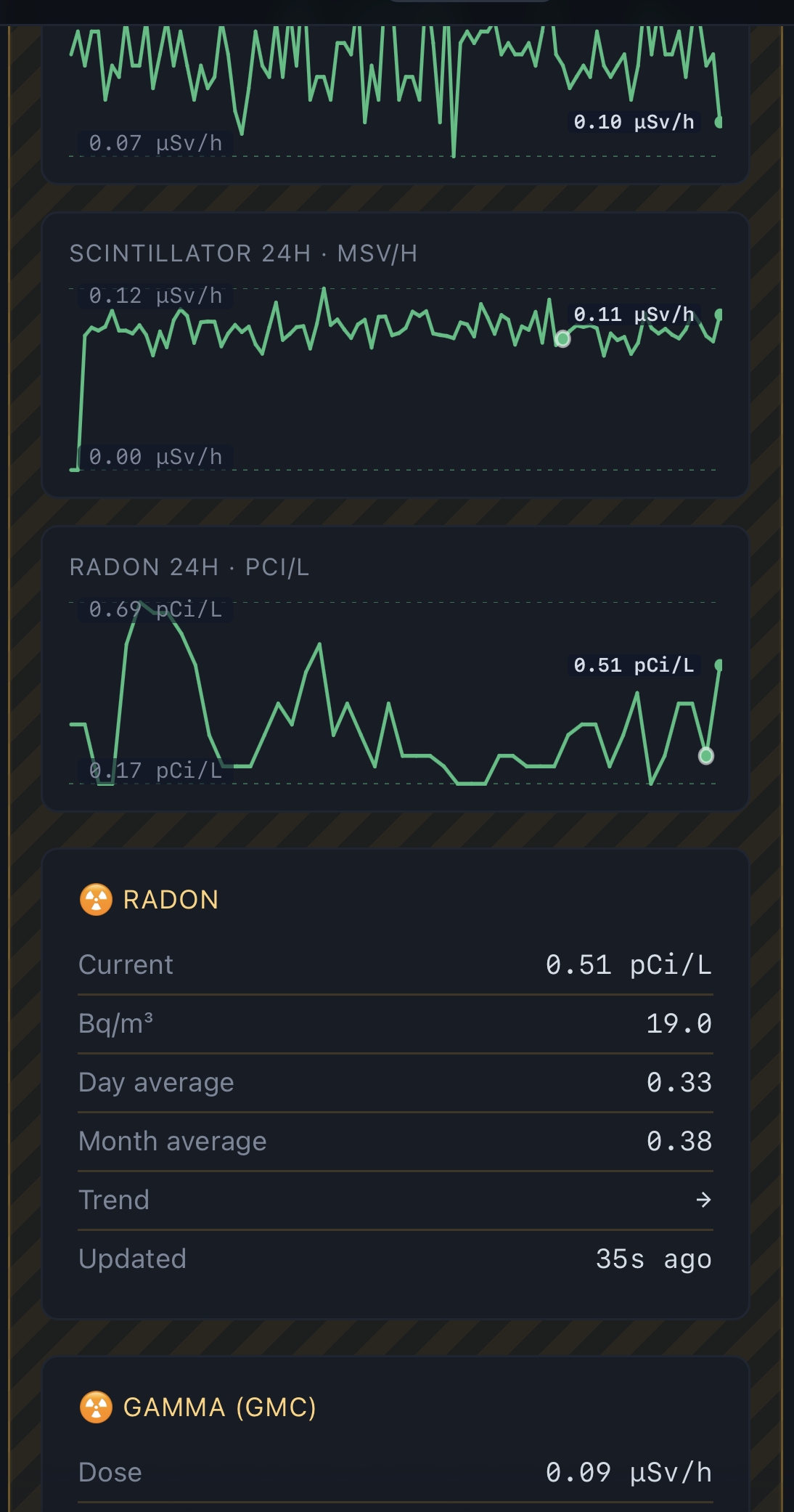
In theory, the GQ devices can be made to run local to HE. I have the GQ GMC600 running local and the 2 have very similar API’s. I didn’t add radon device support cause the data was not actionable in my house, i didn’t see there was a lot of interest in the community and due to device limitations on the GMC600 it required a http proxy to redirect the data to hubitat. i suspect this device will be much of the same and to me requiring an http proxy seamed like a big ask.
If there is interest, i can take a more serious look.
The Wave Radon device arrived. I wonder if I should even pair it with the phone app? I suppose I will. Can always unpair. I came across the link below:
I’m having a radon mitigation system installed in two weeks and would really like something to monitor with as well. So you added it to HA and brought it into Hubitat through that? HA is something I’ve been thinking about diving into for a while and this could be the push I need…
On a side note, I unpaired the detector from the phone. Still works fine on HA/HE. My thinking is that my data is not being shared now. I think the device can store readings on its own for 80(?) days, which I suppose, but am not sure, the phone app could access while HA cannot. I do like those HA graphs though.
Just curious as to why? Radon is a heavy gas that enters homes from below. If you are detecting upstairs, then your downstairs is in serious trouble. Or, you have the temperature inversion thing I mentioned earlier.
Was just checking though. A lot of people hear radiation and radon and react and buy things they don't need or with fear for things they do not understand.
I always like to share my Alpha, Beta, Gamma, and Neutron cookie riddle with people.
You have 4 cookies:
Alpha
Beta
Gamma, and
Neutron
You have to hold one in your hand, put one in your pocket, eat one, and you can throw one away.
Eat the Gamma: Gamma rays are highly penetrating and will pass completely through your body with minimal damage regardless of where you put them. Since there is no escaping exposure, ingesting it spreads out the damage better than being close to a localized external source. Hold the Alpha: Alpha particles have very low penetration and are completely blocked by the dead outer layer of your skin. It is perfectly safe to hold in your bare hand, but highly dangerous if ingested. Pocket the Beta: Beta particles can penetrate skin, but are effectively shielded by a layer of clothing. Putting it in your pocket protects your sensitive hands while your clothing blocks the radiation. Throw away the Neutron: Neutrons are highly penetrating, destructive, and damaging to internal organs. Because there is no immediate, safe way to shield yourself from a neutron cookie on your body, discarding it entirely is the safest option.
For those that do not know, Radon is an alpha particle. It only hurts when it gets past the dead skin layer (open cuts, inhaling, etc). Radon gas is airborn, so it can be breathed in - thus the danger in an enclosed house. But it is easily remediated with airflow and even thin plastic.
It comes up from the ground originating in radioactive minerals (uranium and radium present in most rocks - especially granite). So, the only way for it to get upstairs is to have it drawn up in some very specific air flow scenarios.
Radon can also be found in groundwater from private or small community wells. Radon produced in the ground can dissolve and accumulate in water from underground sources such as wells. When water containing radon is agitated during daily household use - showering, clothes washing or cooking, for example - the radon gas can be released into the air. However, research has shown that drinking water that contains radon is far less harmful than breathing the gas. The health risk does not come from consuming the radon, but from inhaling the gas. And in most cases, the risk of radon entering the home through water is much lower than if it enters through the ground.
Ive been monitoring my radon levels for over 8 years now with a RadonEye RD2000. It has been plugged in since i bought it and with a few exceptions (power outage), it has been on for just about the same time. My integration of choice was Bluetooth for it. It’s local, it’s free, it’s BLE.
There are several open source integrations out there that can help you out. As a matter if fact, i built a virtual air quality driver that exposed via MakerAPI is ready to ingest your radon value.
You can then trigger things based on the value.
I collect data from it, via bluetooth, every minute …
I personally monitor a lot more than Radon, but that’s just me …