I see the debate is starting up again about how we need to stop changing our clocks, and pick a time standard to stay on. Everyone has a good reason to want to stay on one or the other.
For me in the far NE, I would much rather stay on DST. I value the extra hour of light at the end of the day more than morning.
We also are on DST for eight months of the year, and only four on standard time. Seems to me that we should just stay on the time we use most of the year for the least disruption. I can deal with four months of dark mornings, to have it be light until almost 9pm in the summer and not get dark at 4pm in the winter.
I work in IT, and changing clocks is so disruptive to corporate systems. Worse, the site I work at changes the clocks twice a year, while other sites just stay on standard time all year. So it is annoying that for eight months of the year all timestamps on product movements and logs are off by one hour to actual local time from those sites. Fall back is really a pain for us every year, as we have to stop production for an hour, so operations don't complete before they started by timestamp. Still, we then get process times that are an hour shorter than they should have been, which messes with calculating throughput.
Not to mention this does relate to Hubitat, every time change there are some people where the time changed messed up automations that were already scheduled before midnight for the next day or into the week (though usually that is only a problem on the first day after the change).
I know there are good arguments for staying on standard time, specifically studies that show the rise of accidents when on DST, and circadian rhythms based on the sun being directly overhead at 12pm. but I'm not sure I buy into all that, studies or not.
I'm in the western part of the eastern time zone in the US, so I favor standard time. I also start my workday at 6, so having it get darker earlier helps my circadian rhythms. I'm not really a fan of waiting until after 9:30 before it gets dark at night.
There is a big difference in daylight hours between
those in the northern latitudes vs those in southern latitudes. Also it makes a big difference where you live relative to the time zone markers.
For example, those living in Minot, ND are one of the more northerly cities in the US, It is also one of the more westerly cities in Central Time Zone. As such, on the winter solstice in Minot, the sun does not come up until 8:35 am CST. If they were to switch to CDT, the sun would not come up until 9:35 am CDT. I would think that would be rather disruptive to the residents. especially school children.
To those who live in Miami, FL, the days are long enough that it might not matter to them whether they are on EST or EDT.
I work in manufacturing around automation technology and the above simply amazes me - We would NEVER shutdown for a time change (the processes we manage are highly energetic, and a 3 day effort to stop/start), as everything we do on the shop floor, and back end systems is ALWAYS UTC or UNIX time. - Various displays/reports use TZ's to display the current "user" time, but everything in DB's and internal fields for comparisions, sorting, time/date math is UTC. - We also have multiple international sites, which drive such an approach..
But I just am dumbfounded that a facility would shutdown operations for "spring-forward/fallback"... - Now the 2038 issue is another thing to talk about, but I don't want to take this into the weeds.
Apparently YMMV
Also, FYI - China (a long country) just is one TZ, with no DST for the past 30 years or so: Time in China - Wikipedia
Briefly, this is at GF, and I work at what was previously an IBM Microelectronics site. When we joined GF, they were using standard time at their existing sites, but IBM was not.
Due to legacy systems, there was a long list of reasons why we can't just stop changing the time. Those have been worked on a bit, but it has been ten years now and we still change the clocks.
Operations can take a wide variety of time in microelectronics. Some take days, some take less than an hour. It also depends how many wafers are in a lot.
So, we don't actually stop ALL production, we just don't load any product onto a tool for an hour, and we don't do operational outs on any lot that finishes during that hour. That makes sure we get no negative run times. It still knocks an hour off of all processing times for every tool that just ran through the time change.
That is a good point. On the two edges of any time zone, there is already up to an hour difference from what the sun is doing for the same clock time. People in the same time zone, but on two different edges of it, could have their own reasons for which time they want to stay on based if they are on the leading edge or the tailing edge.
Vermont is pretty centered in the Eastern time zone, but there would be about a half hour difference in sun position in Michigan compared to here, even though they are still in the Eastern time zone.
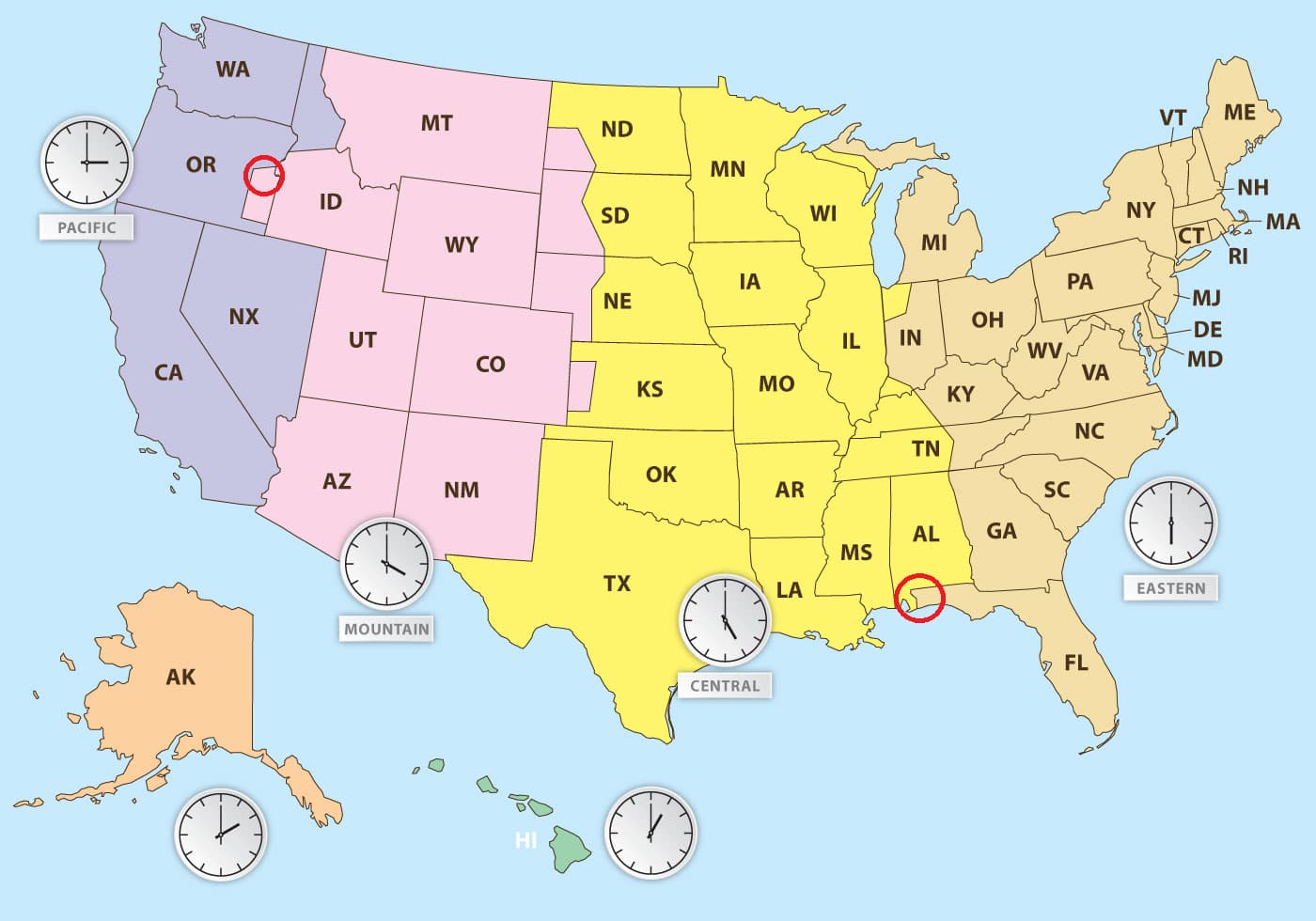
There's never going to be a system that works for everyone. If all time zones were the same width, there would already be an hour difference in solar noon between the people living on the edges of the zone. But all time zones are not the same width... Western Florida is in the Eastern time zone. Part of Oregon is in the Mountain time zone. I expect there's way more than two hours difference in solar noon between those places.
Edit: I need more coffee.. the issue is people in Eastern Alabama are using a clock only 1 hour different to people in Eastern Oregon... and people in Western Florida are using the same time as people in Eastern Maine...
I think that is why we are dragging our feet on getting rid of time changes. Politicians don't want to piss off their constituents by voting the wrong way on which time to keep, but you can't make everyone happy.
If there was ever a need for a Nationwide referendum, this would be it. Nobody will be happy if they don't get a voice in the decision and it gets decided the opposite way of what they wanted by lawmakers.
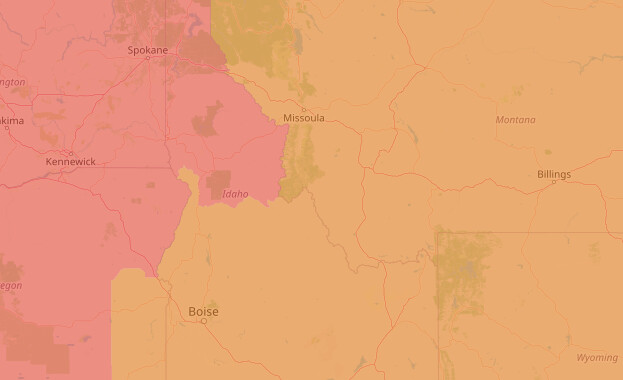
There's always this fun bit between Boise and Spokane...
From that little piece of Mountain time (orange) that's sticking up you can travel north, east, or west and end up in Pacific time. Only due south keeps you in the same time zone... but if you go just a little west and then south, you would go from Mountain to Pacific to Mountain to Pacific.
When we start our day is the key. Put us on Standard time and allow the people to adjust their personal schedules to what works for them. I have lived in the two states which do not do DST. Hawaii and Arizona. Plus Washington and Southern California. I prefer Standard time.
Sunset in the summer between 7:30 - 7-55pm would really mess up my summer. When we camp in July there is still some light at 9pm on DST. We also do a lot of after dinner activities outside in the summer, going beyond 8pm. It would really change the whole summer for me.
I know the tourism industry in Florida have expressed that they want later sunsets as well, due to their business, even though they are in the south. Florida already passed a permanent DST bill, but it never went into effect.
Trump also wants permanent DST, probably the only thing I will ever agree with him on.
The fix for staying on standard time that few people would consider even though it gets to the exact same point is to just start your day an hour earlier.
I start my work day at 8am, even though many I work with start at 9am. Starting at 7am is a bit early for me, and I would then need to have lunch earlier, so I could also then have dinner earlier, to get that hour of light back after dinner is done.
So, changing absolutely everything about my daily schedule doesn't seem like an easy fix to me.
In China, with a single TZ, and everything centered on the capital Bejing, if you further in the west, it's just normal to get up a 4AM, and go to work - as that's when the sun rises, and then you go to bed at 7PM, as it gets dark around 3PM. So you still do you activities when there is light, it's just not not bound to 8AM and 5PM, you more tied to the actual solar schedule (which makes more sense to me anyways) - the numbers on the clock, are just what they are.
Yeah, I see your point, but my time schedule stays the same, even if the time change knocks it an hour off the sun position. I start work at 8pm, I eat lunch around noon, and have dinner around 6pm. None of that changes or needs to, because it stays light at the end of my schedule on DST.
By the time Fall rolls around, there are no after dinner light hours anyway to have to worry about the time change taking light away from after dinner time.
Benjamin Franklin, before time zones or ideas like savings time or electric lights, stated he preferred rising and laying down with the Sun. Wondered why people stayed up late then complained about the price of candles.
I guess the feds have to approve the change and we are still waiting for that approval. My preference would be to stay on DST all year but, even if it's standard time, that would be fine. It's time for the clock changing madness to come to an end already.