We have a powerwall, but about half the time when it switches over, its s bit painful, Just enough power loss to throw everything offline. I picked up a CyberPower UPS, which will be more than enough to carry over. The problem I have is that the cord isn’t long enough. Is it acceptable to plug it into an extension cord? I was thinkingof getting a six foot medium or heavy duty core, like for power tools. Wold that be ok? I am open to suggestions.
If the cord’s appropriately rated and you’re careful not to allow it to partially disconnect at all, it should be fine, although not ideal.
Some appliances can be opened up to allow for the original power cord to be replaced with a longer one.
Most UPSes probably don’t offer that, though.
How long of an extension do you need?
2 Likes
The cord that is on there is a five-foot cord. I said six feet just because of standard lengths, but I think four feet would probably be enough.
I second the use of a heavy-duty extension, at least AWG 12/3 which would be rated for 15A. If you can't find anything else, you could go to your hardware store and get a suitable length of cable and the plug and socket ends and construct one for yourself. The usual wiring colors are like this:
Black = hot
White = Neutral
Green (or bare) = Ground
Plugs are usually set up as a gold/brass colored terminal is for the hot wire. Silver color is for the neutral wire. Green is for ground.
I looked on Amazon and found this one which isn't too long and is AWG 12.
https://www.amazon.com/FNXPOW-Lighted-Outdoor-Extension-Cord/dp/B0CW2HGG4J/ which I think would work well for your situation.
1 Like
I like your suggestion; I was just looking for one. So, if I went to a 10/3, that would be a bit oversized and should give me a bit of extra capacity (not that I need it; I just like to pad things), correct?
Look at the cord and it will tell you what gauge wire it is. Likely 14 or 16 gauge.
Considering most of your wall receptacles are wired with 14-2 Romex you don’t need to get anything more. Those high gauge extension cords are mostly meant for high wattage appliances and power tools and for long runs.
4 Likes
That’s a really thick cord that adds unnecessary weight and bulk for a 15A or 20A circuit.
3 Likes
Especially for such a short run of 6 additional feet.
3 Likes
https://cdn.sparkfun.com/assets/f/d/2/3/3/51155039ce395f5e3d000002.jpg
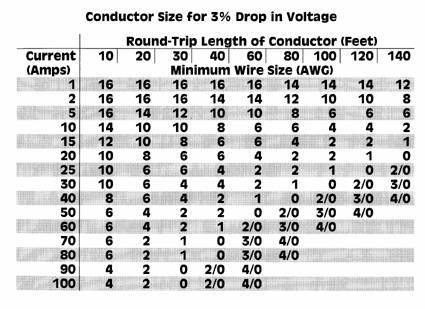
This chart may be helpful.
I have Powerwalls and UPS as a backup. The one thing to remember is that when there is an outage and the Powerwall kicks in, your UPS will start beeping because the Powewall will change the frequency (I think it is 63 Hz) and most UPS think that they need to provide power. I had to get Tesla to change the frequency and it's been good since then.
3 Likes
When off grid, the PowerWall changes the frequency to 65Hz when it is nearly full to force your Solar inverter to turn off, to avoid over charging it. You can ask Tesla and they will lower the offset from 5Hz to 2Hz, which is much better.
BUT... some UPS still don't like 62Hz. I had a bunch of CyberPower UPS and they were annoyed even at 62Hz. @lcw731 look through https://teslamotorsclub.com/tmc/threads/powerwall-2-ups-connundrum-and-solution.130085/
3 Likes
Whoa, I'm not sure I even understand this? Could you elaborate? Looking through that link, it almost looks like CyberPower UPS's don't really even work correctly with a Powerwall. Am I understanding that correctly? If I can get it to work, what setting do I need to ask Tesla to change? This is all way above my head!
Alternating current is so-called because the flow of electricity alternates directions.
The frequency of that alternation is standardized at 60 Hz (the SI unit of measure for cycles per second) in North America.
For whatever reason, Tesla powerwalls, while running on battery, apparently deliver AC current to connected circuits at slightly higher than 60 Hz.
For many electrical devices, that probably doesn’t matter. For UPSes, it would appear as though it does.
Makes sense since the UPS itself contains a battery and software that has to decide whether it’s seeing “normal” power coming from the wall or some kind of abnormal condition that warrants switching to battery backup.
3 Likes
The Powerwall does this to isolate the home from the grid. If there is no grid power and the batteries are full, this shuts off the solar panels and prevents the excess electricity from going back to the grid (so that anyone working on the power line is safe).
2 Likes
I noted the reason above. It's to turn off the solar inverter (which sees an dirty grid connection) to prevent it from overcharging the batteries.
And it only does this until the batteries are under 93% (at least that was the point on my two PW2 system; I've not checked since I added a third PW2).
1 Like
It's all in that thread. "Frequency offset for when off grid". Folks in that thread will help you.
FWIW, my CyberPower UPS's worked fine after I got the PWs.
1 Like