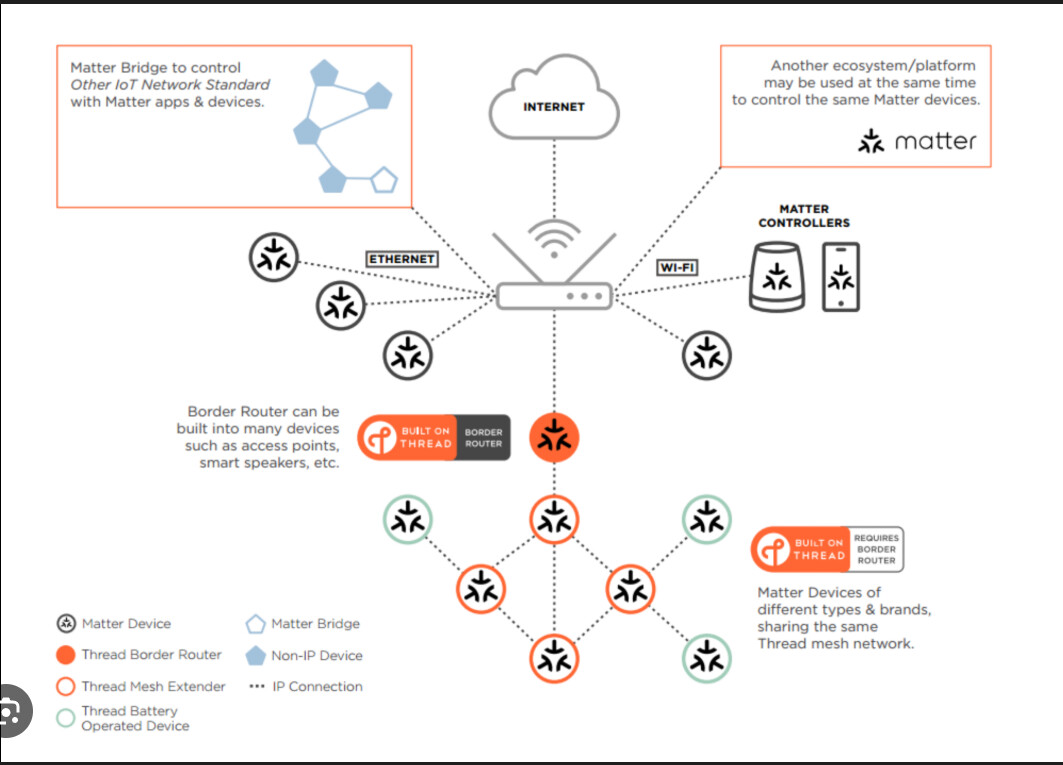
Ah, of course. The TBR talks to the hub over Ethernet. That was silly of me.
Now I had another though, if I use my eero as TBR and share devices via Alexa, I’ve involved the cloud. Would using Apple TV keep it local?
Ah, of course. The TBR talks to the hub over Ethernet. That was silly of me.
Now I had another though, if I use my eero as TBR and share devices via Alexa, I’ve involved the cloud. Would using Apple TV keep it local?
Thread Border router duties are LOCAL. Should not involve the cloud other than when adding new Matter over Thread devices, or when Sharing them with other Matter Controllers (like Hubitat.) My guess is the Alexa App will use the cloud to communicate with the Eero devices for this task, but afterward, the communications SHOULD be all local. Some mesh network systems do not behave well when the Internet is down. Not sure how well Eero works under these conditions.
Also, Amazon seems to lag behind Apple, Aqara, Home Assistant, Google, and other systems. Thus, not sure I would want my Matter over Thread devices relying on any Amazon devices. YMMV, of course.
Apple seems to be one of the most robust and reliable Matter platforms. Apple prioritizes local processing and privacy. Thus, it has been my system of choice for initial Matter commissioning of new devices. I then share those Matter devices (Matter over WiFi or Matter over Thread) with Hubitat, Home Assistant, etc…
I should have included more context from my post a little further up. I am talking about how I would effectively use Hubitat to control the Matter over Thread devices.
If the devices are on the eero mesh (as I had originally indicated was my preference), then my integration between Hubitat and the devices would be via Alexa integration. That, I realized introduced a cloud dependency.
If the devices are on the Apple TV mesh, then the integration would be Hubitat's Apple Home integration. That would be local, right? But as I reread comments in another thread, this may be moot. With my C-7, I apparently will not be able to see those Apple Home devices from Hubitat at all, or would that be possible through the same virtual contact trick used for Alexa?
Well, eero has been at tv 1.4 for a while, and even in 26.3 beta 3, Apple TV isn't, so there's that. I was leaning towards eero for that reason, but I could go either way.
AFAIK, as @JB10 says below, once Apple (or Google, Amazon...) update to 1.4 there will be a way to get the existing thread devices together on the same thread network. So it shouldn't matter too much which thread network you initially add your devices to...
Hopefully I've got that right. 
This isn’t correct. Hubitat would still be able to locally control the IKEA devices regardless of which thread network you put them on. Thread is local regardless of controller. Some, like Alexa, use the cloud to automate when creating them in Alexa. Some are non-cloud dependent (Apple Home) in a sense similar to Hubitat. From a Hubitat perspective, it does not matter which thread network as it would always be local control.
You got it! It might take some times to get the tools in place, but there is light at the end of the tunnel with having only one large thread network rather than multiple competing ones.
Nope.
Nope.
Matter Devices (either Matter over WiFi or Matter over Thread) do not rely on any type of integration between Hubitat and Google, Apple, Alexa, etc... They simply use "Matter" for all communication and connectivity. That is the purpose of the Matter Standard - to unify the way in which all devices and controllers communicate with one another.
One of the reasons for the creation of Matter, and the willingness of the three major players (Apple, Google, and Amazon) to get on board, is that Matter removes the need for custom-built code to integrate devices between these platforms. IF Hubitat were to ever add "Matter Bridge" support to the HE platform, then Hubitat could remove their custom built Alexa Skill, Apple HomeKit integration, and Google Home integration. The Hubitat Zigbee, Z-Wave, and LAN devices would just show up as Matter devices to these other platforms. Likewise, the community-built integrations with platforms like Home Assistant would no longer be needed, as both platforms could simply share their devices with each other via Matter.
While it sounds like a great future, right now Matter still has some growing to do to even reach the same level of device interoperability that old integrations support. It is getting better with each release of Matter, but it still has a ways to go. Thus, the old code will be around for a while still.
How do those devices get seen and controllable in Hubitat? The documentation says ...
The Hubitat Elevation HomeKit Controller app allows you to pair Apple HomeKit devices to your Hubitat Elevation hub. This feature is available only on hub model C-8 Pro only
That's why I said
Edit: OK, I guess you are going to tell me that is talking about non-Matter Home devices. With Matter, that integration is not needed. Am I right now?
Yes!
Hubitat has two "Apple" related integrations.
For Matter devices, none of the above is necessary. Matter allows each device to be shared directly with multiple Matter Controllers. If one wants to do this, then it is important that all Matter devices be commissioned on a platform like Apple, Google, or Alexa first. This is because Hubitat does not currently support sharing Matter devices with other systems. So, if you commision a Mattter device on Apple Home, you can then use the Apple Home app to create a new 'Matter sharing/pairing code' that can be used to add the device to Hubitat's Matter Controller. Once done, the device will communicate directly to the Hubitat Hub (Matter over WiFi devices) or via the Thread Border Router to the HE Hub.
This diagram may help
Thank you for the full and quick response, @ogiewon !
I sent myself down the wrong path of thinking when I stopped reading that doc page when I saw it didn't apply to my hub. Later in that page it says that you wouldn't use it for Matter devices anyway. Now it is clear.
I'm trying to pair an Onvis Matter over Thread Smart Plug S4. I see the previous comments that another Onvis device was in fact Apple Home over Thread device. But this one specifically says Matter over Thread, so I think it should work.
But it isn't. I added to Apple Home and it is controllable from there just fine. When I put it in pairing mode, and copy the code into Add Matter Device in Hubitat (using the web, not the mobile app), it never sees it. I've repeated this many times and I get the same behaviour with another of the same device.
I'm admittedly a newbie to Matter over Thread, but was able to add four MYGGSPRAY sensors previously without this issue.
One thing that confuses me is that Hubitat says the device needs to be close to the hub. And I'm doing that but I don't understand why. The Hubitat hub only communicates to the device through the TBR, or do I misunderstand that?
I think I've got this resolved. Even though it did a firmware upgrade when I first added it to Apple Home, it might have done another one about an hour later. I've now successfully added to Hubitat.
Adventures in establishing a new Thread mesh continue for me. I was becoming very disenchanted with Matter over Thread as my new Onvis smart outlets weren't reliable unless they were in 10-12 feet line of sight with my Apple TV 4k (2022). It then occurred to me that maybe it would do better if the Apple TV wasn't four inches of the floor surrounded by a plethora of home entertainment electronics. Once I hung it from the ceiling, it improved dramatically, although my spousal unit is telling me it isn't going to stay there.
In other news, I am not sure the the Onvis Matter over Thread S4 outlet actually does repeating. Some verbiage I've found says that mains-powered devices usually do, but it isn't a given, and the S4 does not. I've sent a message to Onvis to confirm.
As I'm learning more about the Matter over Thread scenario, I'll share what I think I have now learned.
The Onvis Smart Plug S4 is advertised that it "extends the Thread network." The user manual also says that it will act as a Thread router. However, the Eve app says both Onvis plugs are endpoints. ChatGPT explained to me that a device that can act as a Thread router doesn't necessarily route if the mesh thinks it is stable without it. Fun times.
By the way, elevating the Apple TV out of its hellhole of electronics near the floor had a dramatic effect.
Download the Hubitat app