And it is, your rule dutifully executes a 5-minute delay until the next action. Since there was no next action, the rule simply exited. But before it did, another motion active came in, triggering the rule during the first delay and starting a new sequence of actions, which began with a notification. So you did not observe the delay.
Delay actions only delay the next action in the rule's action sequence, they don't delay anything else, i.e. they don't cause the next trigger to be delayed. Adding pb to your required expression is what can disable the trigger while the action sequence is running (you didn't have to remove the condition you had there before, however, required expressions can have multiple conditions).
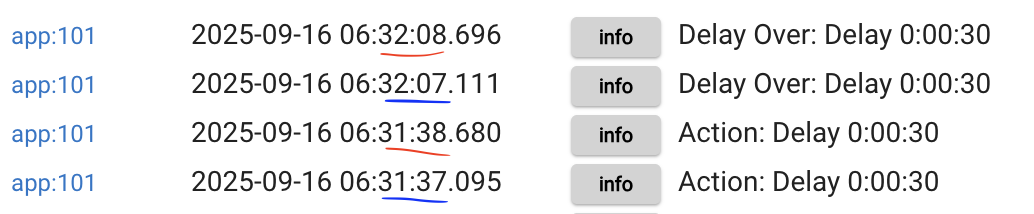
As @hydro311, @bertabcd1234 and others noted, the hub logs would have revealed this. Here is an example screenshot of logs showing two overlapping executions of one rule with only a 30-second delay action:
Your statement, "Start a New Series of Actions" makes me think I may have misspoke in my earlier post due to a lack of understanding.
My understanding is that if a rule is currently executing (waiting 5 minutes in this example), and additional triggers occur, then the first rule will continue running until it reaches its normal termination. The new trigger will start an entirely separate instance (i.e. a new process) to begin.
Is that the case, or does the new trigger terminate the running rule immediately at its current point, and then start a new process from the beginning.
In other words, can a particular rule be running multiple times in memory (all at different stages) or is only a single version allowed.