Someone actually gave some CT relays. I never messed with them...or maybe just a little and didn't know what I was doing. But, the point is, they are a thing.
Maybe something like this:
That has to sense current draw. And there would not be any, or hopefully any, when the main breaker is off.
True.
edit: Although they can be pretty sensitive. Maybe the meter would be enough current draw.
How about something like this?
It would have to be connected to terminals in some, for me, lame fashion. 
I might get one to fool around with. In my case, on the utility feed into my standby generator transfer switch.
Would be cool to see the voltage.
Could attach it to a siren that ANYONE could hear, lol.
edit: oops, DC.
To detect that it would have to be on the inlet to the meter. Not sure the power company would allow that, or if there is any way to get to the feed side. But good thought.
Anything that would wire to the hot side of the main breaker would probably be a NO. The other sensors mentioned don't really wire in, just wind around the wire.
The siren unit is probably going to be the best. If I can't tie into the siren wiring I can always (maybe) rely on the wife to hear it...Yeah right 
I'm thinking you could access it in the panel, but might still be flakey.
I found this:
edit: Anyway, food for thought this morning. I'm thinking of me, of course.
That would be great except.. It would have to be connected on the input side of the main breaker which means it would not be protected. Even if you added a fuse to it there would be a danger of something energized when main is off. I don't know what the code rules are for connecting something to the hot side of a main breaker.
Makes you wonder how the PowerBack works. Just some a wire wrapped around a feed cable.
The instructions show a sensor wrapped around one of the hot legs. Apparently it picks up voltage by induction. It also has a wire connected to the ground terminal.
Unless a CT is installed on the utility side of the main breaker.
But as @neonturbo mentioned and you also recognized, that’s probably not allowed and potentially dangerous if you’re not really comfortable/experienced working inside an electric service panel (since you have no way to turn off the electricity on that side of the main breaker when installing a CT).
In my panel, there is no way to access the feed after the main breaker.
Any whole house smart monitor, eg, the Aeotec flavor, has CTs that install there.
Just have to be careful.
With the main breaker off, you would think there would be no current flow sensed in the feed to the panel. There shouldn't be any parasitic load between the meter and the panel.
I was wrong about the meter potentially being source to sense, since the CT would go on the feed after the meter.
Of course, there are different setups for different utilities, home construction, etc. I'm just relating to my setup.
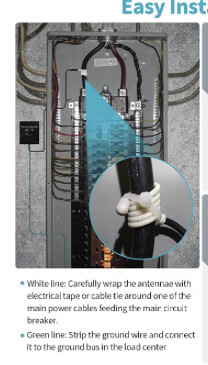
My guess is that it uses the same or similar technology to the non-contact voltage sensors that folks often use to test for voltage in electrical boxes. I always use a voltmeter to check.
I have this exact device. (The reliance controls device that veletfoot mentioned). It’s the “siren” device I mentioned. Works well and is quite loud, but my panel is in a back closet in my basement. I can’t hear it from the 2nd story.
A vibration sensor might pick it up, allowing you to relay it ?
Thanksgiving four or five years ago power went out for about 6 hours during the middle of the day. Somebody ran their car into a nearby substation. I had been thinking of getting a generator and after this I decided I would. I thought about a whole house but decided it was too much money. I have been with the same power company since I moved back to middle GA in 91. We lost power for about 3 days that first winter back as we had a freak ice storm. Since then in all the places I lived we might have lost power at the most for and hour or two. So instead of a whole house I added the hookup for a portable generator. I hook it up and run it every month for 5 minutes, every three months I hook it up to my shop and run it for 30 minutes. I also got a dual fuel generator and I keep 4 30 lb propane tanks on hand. So all prepared. Since installing it four years ago, we might have lost power for 5 minutes at the most.
Very similar to my experience. In the 56 years we've been married the longest we have been without power is 2 hours. That's between 6 houses. Our current house has underground utilities but they go above ground just a block away.
I think my main concern these days is not the ice or storms but the state of the grid control. As we've seen the last few days it doesn't take much to cribble some part of the infra structure.
I also thought about a whole house but can't justify the expense. Calculated all the items we have to have and a 4000 watt portable is way more then needed. So I'll be doing what you do and run it every month or so. I did order a dual fuel so will also keep propane tanks as well as gas.
Lord willing we won't need any of it but as the missus says, " Better to be Prepared".