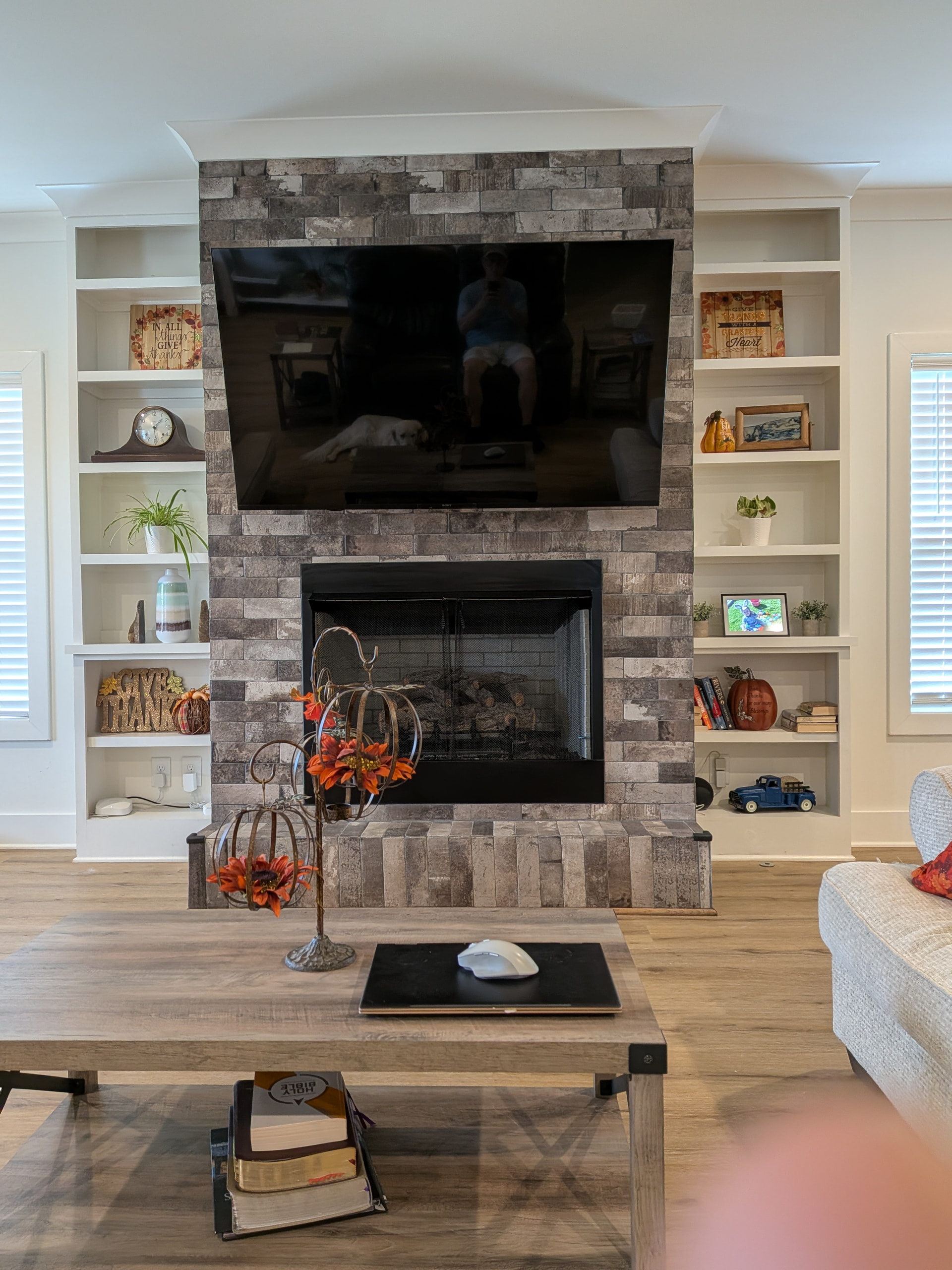
If you can take a picture showing the overall layout (including the outlets) that could be helpful.
As for possible ideas, what about some thin LED strip lighting with power leading down from there to a Zigbee (or your preferred method) controller? The controller could then be handled by a timer, motion sensor, presence sensor, or however you want. You could choose an LED strip in a particular white, but you could also go with one that is RGBW or RGB+CCT if you want to allow for accent lighting.
The most "advanced" would be to use individually addressable LEDs (or addressable sections) so you could control each shelf (or even portions of shelves if you are highlighting specific items on them). A WLED controller could easily handle such a scenario.
My preference is to have single control of all lights.
Power to each light down through each section w/ having a ton of bundled wire in each section is a concern, I could cut/splice in each section to keep wire to a min.
I have no preference for a controller, have used a zoo smart relay in the past for some outside lights.
Do you want single color, RGB, RGBW/RGB+CCT, or individually controllable?
The first is easiest (just splice into the power lines). The second and third are similar (it will be more splices. The last would require more effort, planning, and certainly cost. All of them have different recommendations also...
A single controller might be nice, but then you have to run wires across the center line (and it might be getting too long from the looks of it). Likely easier to go with two controllers that you just mirror.
I have had good luck with the GLEDOPTO series of products. Below are some Amazon links for models that might be of interest. The first two are ZigBee, the third is a WiFi WLED (NOT Matter, but there are Hubitat integrations people have made for it), the fourth one is a Matter model (I have not tried one of their Matter ones yet). I added a fifth (that I found while writing this up) that is also an ESP32 WLED model but it includes and Ethernet jack(!).
Also a couple links for LED strips although I do not have a specific brand I rely on for those... I have used many different ones for different projects over time. I did not have any good recommendations for connectors or power supplies because that can vary by the type of LED strip you get.
Finally, I included one kit that I found while searching otherwise that was something I had not seen before. It is apparently an RGB (addressable) with separate CW and WW channels, making it effectively RGB+CCT. I ordered one of these because it seems so strange I wanted to check it out...
Well, I got the GLEOPTO ZigBee 3.0 RGBCCT LED Strip Controller Pro, strip lights and power supply. Installed into the first 2 bookshelves. Got the controller connected to HE and can control it via the device.
Anyone had any luck with syncing to the TV w/o a HUE bridge using Screenbloom?
Also, haven't started digging into HE apps to control things via automations, any suggestions for basic color changing, time of day...
Love to see a picture once you are all set with it.
I have no HUE stuff, so cannot help there. As for automation ideas:
Have it brighter (or on) at sunrise for an hour or two. Then dim/off. Then have it come back bright/on around sunset until going dim/off for bedtime.
Tie to motion sensor(s). When someone comes up it can brighten/turn on.
Seasonal lighting. Change ambient color to come closer to seasons (orange for fall, either cool white/light blue for winter or a warmer tone so it does not feel cold, etc...).
Slow blending of color (one of the fading rainbow patterns) can sometimes look nice as an ambient.
Got the first 4 shelves wired and mounted, immediately noticed the bottom light next to the controller and power supply is the brightest, each light strip going up gets a little dimmer.
I have checked for 24v going into and out of the controller. Can't measure voltage at the light strip as there appears to be a coating over the copper leads, the connectors puncture the leads to make the connection. All connections are good from what I can tell.
Using 22ga wire between light strips as that is what the connectors require
When viewing colors, the different is not really too noticable but when on soft white at say 25%, you can really see the difference going up
Is this to be expected with the cheap lights on Amazon vs. what can be found at LED stores that sell for 5-10x the price? IOW, pay once, cry once and get better quality, if that is really a thing?
For my son’s shelves we ran the strips under shelves and made a “buss” using 14guage wire up the edge out of site and tapped each strip off in parallel.
interesting, can you give me a diagram of how this was wired? My bookcases don't have much room to hid stuff and so far, I can't picture how this was done
Two 16 gauge wires, blank & white, pulled from ROMEX, were run up outside of shelving temporarily taped in place.
Holes drilled through the side under shelf in line with strip. Strip runs out of hole and power connected to black & white wires which are moved to line up with holes.
Do same for each shelf. Staple b&w wire to outside.
Add quarter-round or other decorative moulding vertically in front of b&w to hide from view.
Feed power to b&w wherever convenient. Hole through side near bottom. From outside.
So if I'm understanding correctly you're running a unique black and white wire to each shelf then you take all blacks and all whites into two bus bars. Those two bus bars then have a single wire that goes to the controller.
Are you soldering all of the black, white and four color wires to each light strip?
It's highly likely I'm fundamentally missing how you pulled this off
This is a pretty common issue for longer LED strip runs "voltage drop". Although 24V will usually avoid it with smaller systems, the very small wire could be what is causing it. Having the power run primarily off heavier wire should help if not solve it entirely.
Here are a couple links about it:
I saw it many years back with an outside LED strip setup I had done for Christmas. However, since the power input was at the top of the pole the fact that it faded out did not look bad by the time it got towards the ground (and only I really noticed it). That idea did not survive the full winter though and I have not made something like that since (and I know how to avoid voltage drop now).