I just did a full measurement. Each length will be 55 feet, Though it's broken up a bit because of doors. I'll post a drawing.
Think meters - All the power and density factors are per meter, and strips are sold in "m" reels. Fortunately, we all use SI for electrical measurements.
Sure!
LEDs:
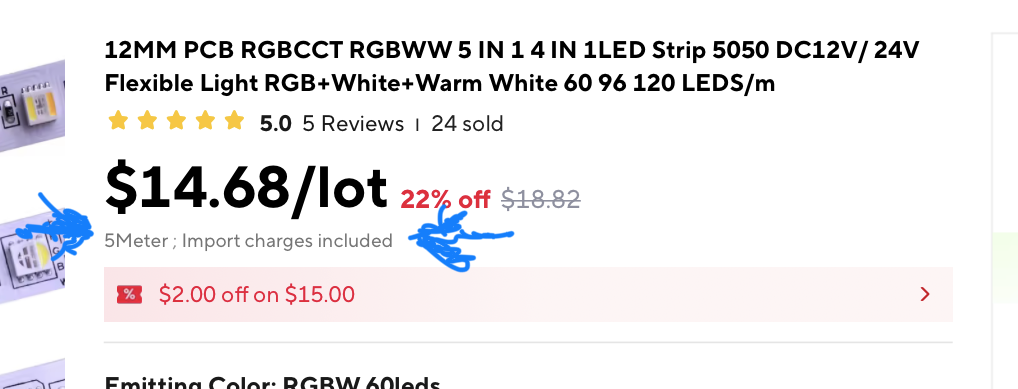
12MM PCB RGBCCT RGBWW 5 IN 1 4 IN 1LED Strip 5050 DC12V/ 24V Flexible Light RGB+White+Warm White 60 96 120 LED... https://www.aliexpress.com/item/1005001496577263.html?channel=twinner
Controller:
GLEDOPTO GL-C-201P/202P/203P 5 in 1 ZigBee 3.0 Pro+ LED Controller RGB CCT RGBW RGBCCT Strip Light Smart APP... https://www.aliexpress.com/item/1005008554319757.html?channel=twinner
1 Like
Careful guys, this is not what the OP asked for, he wanted addressable LED strips (where each pixel can be at a different color), this is not it, these will only light up a single color for all the length of the sstrip!
3 Likes
WLED novice here...how do you tell length from this? I don't see a length option And they are listed as both "5 in 1" and "4 in 1" - what doees that mean? 


WLED controller is for the ADDRESSABLE LED Strips. The strips you mentioned are not ADDRESSABLE. They are RGBW (4 in 1) or RGBWW (5 in 1). These strips will be the same color for the entire strip. For the ADDRESSABLE strips you can set each LED to whatever color you want. You can calculate the strip length by diving total number of LEDs (should be specified) by "LED per meter" value.
1 Like
Yup, thanks @nclark also noted that above. Not addressable.
1 Like
These are mine
https://www.amazon.co.uk/BTF-LIGHTING-Individual-Addressable-300Pixels-Non-Waterproof/dp/B088B9QWHT
I see those are 5 meter/16.4 feet @ 5v, will 5v power that entire strip? Also do they do WW? (Not clear from the description)
@rlithgow1, I have used BTF LED strips, and they are very high quality and work very well.
Here is the main BTF store on Amazon...
https://www.amazon.com/stores/BTF-LIGHTING/page/0FF60378-45DE-44E7-B0D7-8F5CD6478971
Or the Addressable LED strips only part of the store on Amazon...
https://www.amazon.com/stores/page/A124F766-0BC7-4F30-A2E2-58F3C3B530F7
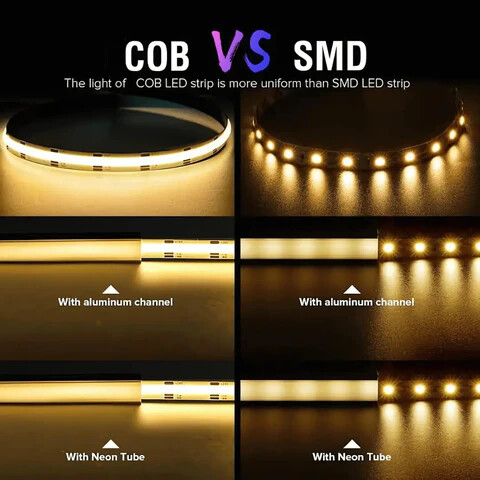
BTW, no one mentioned (that I have read) about pixel density, the closer the LEDs are to one another, the less you will have hotspots in the light channel and the cleaner it is. When you don't really see the lights like in under counter lighting, this is not as important because you are looking at the projection. But in your case, you will be seeing the strips on the wall, and a higher density LED strip is a must! They also have COB light strips that are very high density and will give a very clean strip all around without any hotspots.
3 Likes
I'm looking at this controller. Pre-Assembled QuinLED-Dig-Quad - quinled.info
I realize I will have to have breaks in the bars. Looking at the wiring instructions it looks like I can power 7 different sections/injection points. @ 16 meters 300 pixel density, will 5 volt be ok?
Personally I would go with min 12V since you have breaks in the lines, do injection at each break by running 18-22 gauge wire in the wall. But then again, if the longest run is less 20 feet, you could get away with 5V but will need to inject at both ends. Anything longer, you should go to 12V, and as I stated above, the Power Supply will be smaller in Amps if you go to 12V or even 24V.
As for how to wire the data line, I would do a continues run for each of the 2 channels/strip, don't forget to follow the direction of the arrow printed on the strips, so at the end of the first segment solder a wire to the data line and bring it to the beginning of the next strip. This will make things easier to program in WLED.
But I think you can actually have a single line be on different channels and rematch them in WLED so that they appear as a lingle strip/channel, I have never done this myself so you will need to read up on this or maybe get support from another member here or even DrZZs if you buy from him, he knows his stuff!
The controller I listed above is capable of 4 channels. Though with everything open at the moment I can just pull wire through the frame work.
I'm a little confused on the acronum/part numbers for BTC. So basically I think I want 12v, 300led pm individually addressable LED strips @ 5 meters. Which BTC strip do I want?
Given how you plan these to be directly visible on the walls, and not indirect/undercounter lighting - I would go with a higher density than 60leds/M (your 300 LEDS for 5 M), unless your going with very opaque defusers. Your going to see the SMD "spots" with that low of a density - Fine for indirect usage.
I wouldn't go below 84/M, and I'm still have a preference for 24V over 12 just so you can have higher gauge feed wires and worry less about heat and resistance losses - But what @nclark proposes above with 12V will likely work with more than just a single power injection on one end (either both ends, or at a midpoint for the strip breaks)
Finally, with PixelBlaze IO Extender, all the individually powered strips/channels (which can even speak different chip protocols and be different densities) are logically combined into a single long strip for programming - It's actually takes more effort to split things back apart into different segments of control. There are pros/cons for WLED versus PixelBlaze.
But your asking all the correct questions now, and it sounds like you have a better grasp of options, limitations, and decision criteria. My only final recommendation, is buy the strips from someplace that has a return policy - And to a mock up on your walls using actual distances and the planned strips - You can do lots of math, planning and bench testing, but the real installation always throws you some curves.
Just my unsolicited experiences.
4 Likes
If you look at the first posts he's intending to use diffused aluminum channel. That helps. Not only that these are deep channel so the led density is a bit more forgiving.
To the OP. The various sites like wled and quinled have buyer guide pages for strip types. Those are pretty helpful when looking at off brands and you need to know the chip type etc.
https://kno.wled.ge/basics/compatible-led-strips/#addressable-led-strips
1 Like
Agreed - It also depends on the diffuser - You can get then in various levels of "opacity" (is that a word?) from clear, pearl, white, smoked, black etc.
Finally, it really depends on the "look" you want/like and the diffuser is a big part of that - as it's clearly visible in this installation when the LEDs are off.
Hence my suggest to buy several different brightness and density of strips and try them out. - And return what doesn't suit you - I ended up buying 10x 5m strips for my actual deployment, and returned 5 other different makes/densities/power requirements during my various "trials"
1 Like
What are COB and SMD (2 of the acronyms I'm unsure of)
Additional question. Since I'm using track and will be mating open ends in the corners, am I better off just bending the light strip or cutting and re splicing with 22a so it's easier to make the corner?
COB - Chip On Board
SMD - Surface Mount Design
The COB strip looks like a continuous band of light. SMD is individual LEDs on the strip as it is for RGB, RGBW etc so that's where the LEDs per metre are important; the more there is, the more even it looks along it's length which is more important where the strip is directly visible.
2 Likes