Improvements to Hubitat

I’ve been using Hubitat for a very long time. I came from SmartThings eons ago. Over the years I have seen Hubitat grow and improve.

That said, while my setup has been pretty reliable and stable, it has slowly degraded over time and requires more and more maintenance. At this point you’re thinking, here it comes.

Here it is, my system is aging, my old GE/Jasco switches never were great, but are much worse now and failing, my myriad of older Zigbee sensors are starting to randomly have issues, and don’t get me started on the constant battery replacements, etc.

First off, I am heavily into the UniFi ecosystem. My network has never been more solid, and using Protect for cameras and events is awesome. Here’s what I did to improve things a lot.

I replaced my sensors with the UniFi Superlink sensors. This has grown as more sensors come out from UniFi. I have 63 sensors installed as of now, all integrated using webhooks via MakerAPI. Response times are super quick. While the sensors were installed starting in 2025, no battery replacements yet (I know it’s too soon, but I hated dealing with all of the different types of batteries, etc). I still have some specialized Zigbee sensors, mostly created by me, that still work, even with the reduced Zigbee mesh size (they’re proximity to the hub is key).

I replaced my 68 switches, dimmers, etc. with Zooz LR equivalents. These have also been rock solid with quick responses. I do have 8 Zen75’s that I still need to install. Shout out to @jtp10181 for his work on the drivers. I was concerned at first when switching from a Z-wave mesh network to a star network, but after having used it for a while, it’s solid (even to my outbuilding).

I do use Home Assistant, basically to bring in some integrations via HADB and for dashboards (sorry) via HACS/Hubitat.

Overall I feel that my system is robust, full featured, and reliable. I have a hard time dreaming up things that add value to my setup at this point. Yes, updating everything cost a lot, and I acknowledge that everyone’s situation and abilities are different, but all of this took my aging system to the next level. It’s more reliably than it ever was. I have no complaints (not that I complained a lot before).

To summarize, I have no complaints with Hubitat. Hubitat was not the problem for my system, my aging infrastructure was. Great job Hubitat.

I just wanted to share (not argue about my choices). I thought Hubitat and others might want to hear this. I had thought that the age was a factor and I decided to take the risk and update things. I am glad I did. I expected improvements, but wow.

12 Likes

I've been able to just play with new device types for quite a long time, with no problems from the hub. Having the right devices and/or a solid mesh makes all the difference with your experience.

2 Likes

I still have many devices that are getting on the eight year range now for age, but I don't think they are causing performance issues, as I don't seem to have performance issues.

My first Jasco/GE dimmer died last month. I'm hoping I have not reached a point where things start dying regularly due to age. As is, I am still only planning to update devices when they actually die, or they can be traced to causing an issue.

2 Likes

I had a lot dating back to 2013.

My system functioned “well”, my meshes were very strong. No complaints from the family. But I noticed things.

The family did notice the upgrades.

I started with Smartthings in 2015 and moved to Hubitat in 2020. I'm still running the C5 I purchased in 2020.

I have had two device types that have failed over the years. The first being the original Z-wave (non-plus) GE switches. I still have a couple of these in some out of the way locations and as these die, I'll swap them out with Zooz, like I did the rest. I have had success Zooz. The other device type I have lost over the years has been a handful of the Iris V2 motion sensors. For me, they never completely die. They either start eating batteries or just quit reliably sensing motion. The sensors in the latter group I have recycled into temp sensors for the fridge and freezers.

Overall, other than the occasional oddity, everything here is very stable.

3 Likes

I must admit that until I read your note, I had never heard of UniFI Superlink Sensors.
I have used (and installed) UniFI network gear, and I have always been impressed by the "industrial strength" of their products. In my mind, it was always "one step above" the typical "prosumer" networking gear.
In terms of their sensors, what kind of range do they really have?
For example, what is the maximum distance that a water leak sensor could be from the hub?
Can their typical networking gear handle all those sensors without coughing?
What kind of batteries do they use? (I'm also very tired of changing batteries all the time...)

2 Likes

CR123

Here is a link to their current offerings. Of course the required SuperLink Gateway is out of stock:

According to the SuperLink page it supports 2KM range. There is an optional high gain antenna too.

2 Likes

I haven’t pushed the range beyond 250 ft to the out building (not line of site). I lose a bar or two, but no issues. Very responsive.

UniFi works fine no hiccups.

The CR123’s are up for the job. Even if I get 2-3 years out them, instead of the 5-6 years advertised, I’d be happy. I am just so sick of 2032, 2450, 2477, CR2, etc, and then batteries not being of decent quality and not lasting or being as “fresh” as they’re supposed to be.

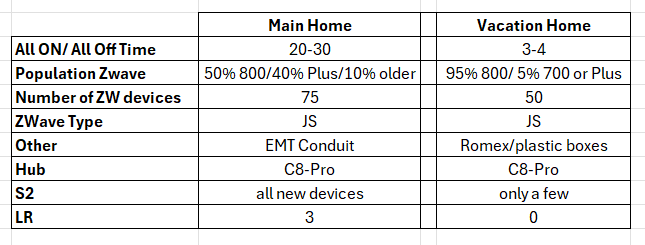
Good summary. I came over from another hub after 10 years there. I was fortunate in that a new vacation home was my first target with Hubitat (C8-Pro) and so I purchased all new ZWave devices and a few Zigbee and one or two Matter devices.

This system has been quite good as most ZWave devices are 800 series chips.

After a while I decided to retire my old hub system (and put in a C8-Pro as well) in my main home. It was a different challenge because I have a lot of ZWave devices of various vintage dating back 10 years. Many not even ZWave Plus. I ended up retiring a lot of the ancient stuff and went mostly with Zooz as I did in the vacation home. I would say 1/2 the 75 or so devices are still on the older side though. I was grateful for Zooz's holiday sale which allowed significant savings for my upgrade.

I have moved both systems to Z-Wave JS now but they operate much differently. My system with some older devices takes 20-30 seconds to complete an all off or all on rule (75 Devices). I used S2 security for all new devices in the main home but paired without S2 on most of the devices at the vacation home (I was swayed by the older warning to only use S2 if you absolutely needed it, I have since learned that warning was overdone).

On the vacation home and slightly fewer number of devices (50) those same rules run in 3-4 seconds. So there is a big disparity on how ZWave runs with old devices vs newer 800 series devices. While Z-Wave claims backwards compatibility, the reality suggests there are some issues with older devices commingled with new devices. Now in fairness my main home is in Illinois where the home wiring is all in EMT conduit (yes it is stupid but it is the code) so that may be a contributing factor.

image

1 Like

I tried ZwaveJS for months, but had issues. I switched back to Zip and haven’t ventured back. How is it in its latest incarnation?

Interesting. Appears to be based on LoRa (similar to e.g. Yolink).

2 Likes

I went to JS reluctantly but needed to because it handles ghost devices better. I intended to go back to zip but never did. So I have no complaints with JS. I think some of the highly knowledgeable on this forum seem to be positive to JS. It is the future given Zip being EOL.

2 Likes