I'm curious about other people's experience here, regarding the amount of time spent on the home automation hobby.
I don't think I envisioned when starting down this road how much time I was going to put in. I'm sure it's been many hundreds--probably thousands--of hours of setup. And because of the admittedly unnecessary complexity I've created (Hubitat is showing that I have 908 devices--many virtual or from Home Assistant Device Bridge, but still...yikes), I must average at least an hour per day for tracking down and fixing issues--today it's Denon HEOS integration problems; yesterday was Govee light issues and a flaky illumination sensor; the day before that it was Ring alarm devices that were offline and Hubitat database corruption requiring a soft reset. And so on.
I'm sure you know what I'm talking about. Between Hubitat, Home Assistant, Alexa, and about 20 Docker containers, there are lots of potential software failure points, and then there are of course hardware issues--sensors becoming unresponsive, Z-wave and Zigbee problems, batteries dying, etc. And of course there are the things I've screwed up in writing automation rules that I need to figure out.
I do like tinkering, so this isn't all bad, and I've learned a lot along the way. But it leads me to ask: Do other people spend this much time? And do they find it worthwhile?
If home automation is supposed to be a time saver, it certainly hasn't worked out that way for me!
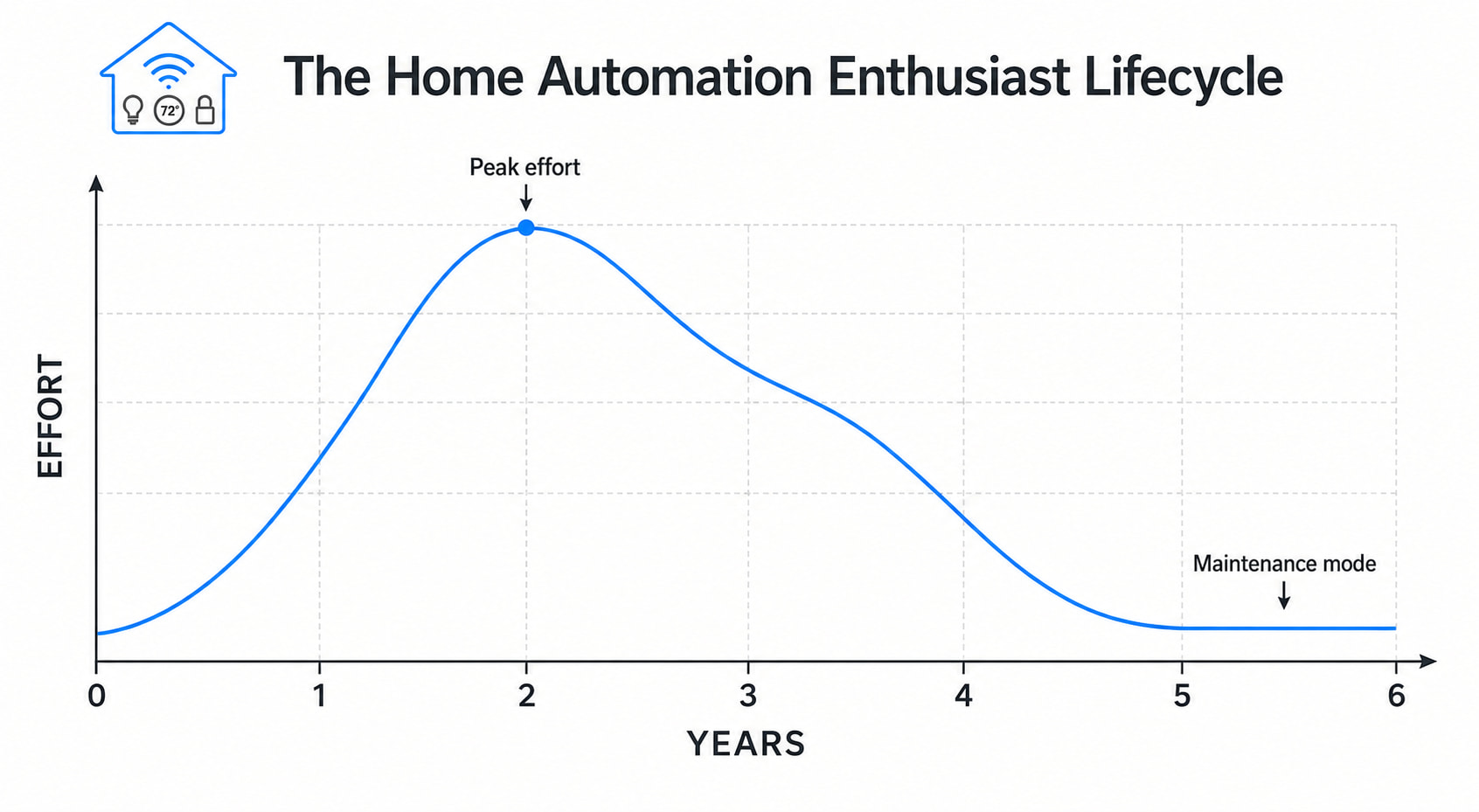
Based on my experience, most home automation enthusiasts begin with a simple goal: create the perfect automated environment. Before long, that enthusiasm leads to hundreds of devices, increasingly complex rules, countless conditions, and automations designed to anticipate every possible situation.
Effort usually peaks around the second year, when users are constantly adding, refining, troubleshooting, and redesigning. Unfortunately, the maintenance required later is often directly related to the high complexity that was created during that enthusiastic phase.
With experience, however, the priorities begin to gradually change. Users learn that the most effective automations are not necessarily the most elaborate—they are the ones that work reliably, feel natural, and rarely require attention.
Over time, unnecessary rules are removed, overlapping automations are consolidated, and complicated solutions are replaced with simpler ones.
Eventually, the system reaches “maintenance mode,” where it quietly does its job with minimal intervention.
The real sign of a truly smart home isn’t how complicated the system has become, but rather how simple the users have learned to make it.
I agree with this completely. But there are some other variables.
I had a limited number of devices - maybe 60 or so when I started automating my house (2013-2015). And it stayed at that number till 2019 when I switched to Hubitat. The response time of local automation is addictive. I think I ended up with over 350 physical devices split between three hubs in a relatively small 3-bedroom townhouse
When I moved 3 years ago, I decided to simplify and focus on the most important automations. Took about 6 months to get this house setup. I have a single C-8 Pro, about 250 physical devices, and automations that are both essential and robust.
And things have pretty much been in maintenance mode since then. I need to change batteries a couple times a month, but I don't fiddle too much with automations.
There are probably lessons in there I should learn--now over 5 years into Hubitat. I have tended to weed out less reliable hardware, rules, etc., as I find better ways to do things. Paradoxically, that's probably where much of my time goes. I'm not sure I'm going to get to "rarely require attention" though!
Human moods cannot be automated. People do not always want the same thing under the same conditions, regardless of how perfectly crafted the automation may be.
When to move on from unreliable devices. Sometimes the best solution is to replace a problematic device rather than stubbornly investing more time and effort trying to make it work.
I find that as I get everything stable and working and go into "maintenance mode," I will eventually want to get back into the hobby of actually adding things with the hub.
I either find something else to automate, or I go back and make improvements to what I already have. The problem with maintenance mode is that it effectively ends your hobby time.
It is always more fun to add things and improve them over fixing things that break. Even maintenance mode keeps me somewhat busy with changing batteries, or updating the hub, or fixing something that may have broken or had a bug I didn't realize until later. Maintenance mode seems more like a job than a hobby, though.
I tend to go to maintenance mode in the summer, when I have so many other things to do with my weekends, but fall and winter is when I dive back in and make additions or improvements. It is a great way to spend time on a cold winter weekend.
The excitement of your hobby doesn’t have to end once your home reaches maintenance mode. Set up a separate playground for experiments—one that doesn’t affect your primary system. You can continue tinkering and exploring new ideas while keeping your family happy and everyone’s stress levels low.
I consider all of this more of a Home Convenience system versus a Home Automation system. I could never completely automate my home because of the above. I see it more in the HA community where users' goals are to completely automate their house. I don't think that's even possible again for the above. I see it brought up a lot during discussions of dashboards and a common response is "Why do you need dashboards? Your house should be automated!"
After almost a decade (I'm a very slow learner) I have disabled most of the rules that turn on lights when entering a room. My brides "needs" are never the same from day to day and I finally grew tired of fighting the battle. I personally miss not having to mess with light switches but since making the change, I have not heard a single complaint about anything automation related.
Having programmed & maintained several full-blown business systems in the distant past, I learned the hard way that creeping elegance comes back to bite you every time.
My start was a single goal.... Stop my kids from leaving the house with the garage door standing wide open (my expensive bikes are just hanging on the wall in there). I did that with a very old (by home automation standards) wired gateway from IOBridge.
Once that was done, and the bug was in my ear about different ways to solve problems, my automation situation grew. I went from IOBridge to SmarThings to HE and then added HA for a very few things. I am now at ~350 devices (some virtual - most not). But, the majority of growth was for solving specific issues - not automation just because I could. (Removing the need to push buttons is a specific issue.... right? right??)
I might spend an hour a week unless I have an issue I am solving. Most of the time, my hubs (HE and HA) just hum right along doing their thing.
In the beginning, (especially on the old IO Bridge) I had the learning curve and research into how to do what I wanted to do without having to do it again or fix it later (grew up on a farm where the mantra was "do it right or don't bother") So, I probably spent more time on research than I did actually setting things up. The upside to that has been a stable system that rarely has issues.
Is it a hobby? Sure. But not one I spend a ridiculous amount of time on. Is it a time sink? Not really, not for me.
I will just say this. Replacing a physical switch with a dashboard is not what I would call automation. If I have to get up and walk to the wall (or even ask google to do it), that is not "automation". I can see where others may want to gadgetize, and I definitely do not judge on that. But, I would not consider it automation.
To answer the question though, there ALWAYS needs to be a backup system to automation. Many of (yes, this is hyperbolic generalization) those who say "who needs a dashboard?" are also the same ones who get rid of all the manual back up processes and complain when the system goes down and they can't control anything. This was really prevalent on Smartthings and other cloud based systems.
The point is, I agree that dashboards in my case are more for decoration, checking the status of things, and functional to bypass automations when my "ideal" use case didn't pan out for some reason. But also in my case, they are rarely if ever actually used (Except for my weather dashboard that acts as a screensaver on my tablets). So, not needing them for anything 95-99% of the time, I do not have an understanding for why they are so controversial for most.
"Would suck to be the next guy, especially when I'm the next guy."
My main concern is long-term maintenance. At the peak of bobbyd's graph you're likely to be proficient with the code and understand the nuances of the system. That fades, you forget bits & pieces, meanwhile firmware & functionality have continued to evolve. You get out to Year 5 and now find that you're the next guy.
I mainly use dashboards for monitoring and diagnosis. For instance, I have a dashboard with all of my motion sensors, so I can see at a glance if something is stuck as active when it shouldn't be.
I rarely use dashboards to control lights, which are automated or I use voice control. The only things I change via a dashboard are some settings--like turning on my guest mode or changing the hot tub temperature.
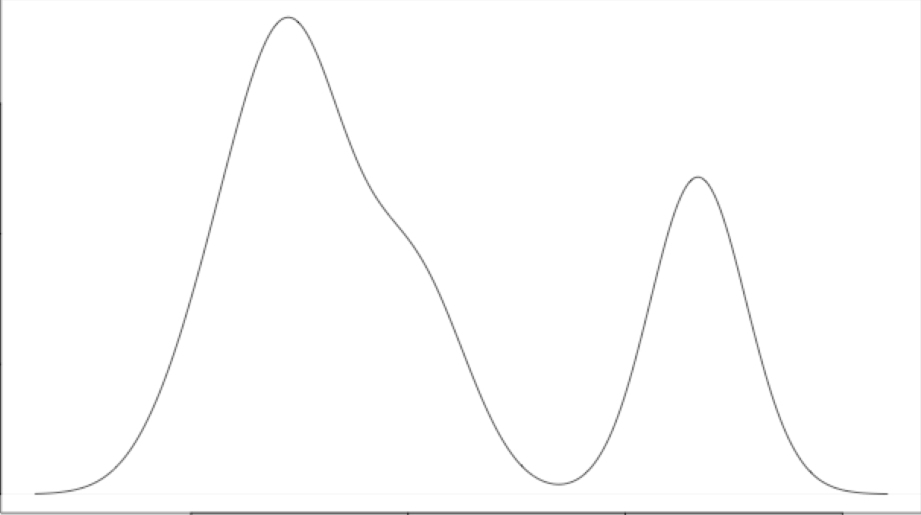
There will be periods of relearning—and undoing what you previously built that you no longer know why you did it — but the effort is usually shorter, and the overall pattern remains the same. Each spike requires less effort than the one before it, while the long-term trajectory continues downward toward simplicity.
It is nice that my automations turn the lights turn on when we enter the room, but my big one for early automations was turning the lights off when people leave the room. People in my house just can't turn off lights when they leave.
I kept hearing the song I write Sins Not Tragedies in my head, except it would go, "Haven't you people ever heard of, shutting off the goddamn lights!"
It is so much more now though. Automations do what people want them to do at least 90% of the time, and when they don't the dashboards let them override an automation and turn off motion sensors, etc. All my lights use Zwave switches, so there is always the physical option, but without disabling automations, the lights will go back to automation state.
One improvement I still need want to add is that when someone adjusts a light manually, it removes that light from the scene automations automatically for some period of time.
I have many automations that have nothing to do with human behaviors, though. Irrigation controllers, running the pool stuff, keeping my attic cool and humidity free, running my HVAC, auto filling outside fountains, stuff like that. I have a lot of systematic automations now that are not based on what people are doing.
Many hours each week. I guess its a hobby. I've been at it for years but I've only been using Hubitat for about the last 5 years. Its something fun and entertaining to keep your mind in shape and as a side benefit, its often useful.
I refuse to call it a time sink. I just spent 11 hours automating something that took 3 seconds to do manually. And now that it finally works perfectly, I can tear it all apart and do it a different way.