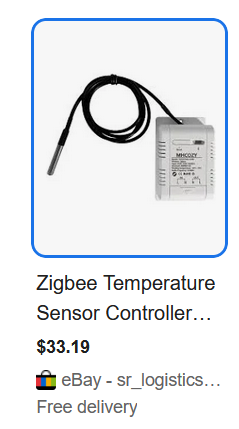
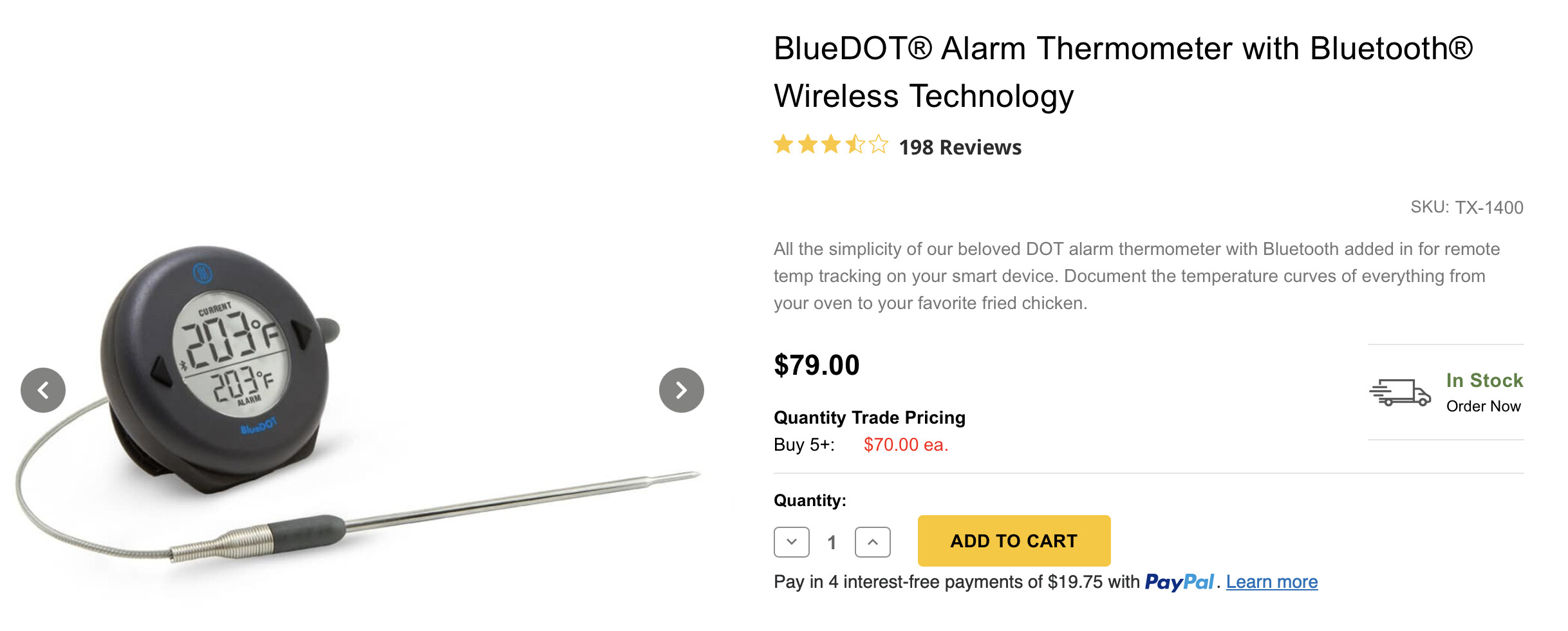
So, that was what I was talking about when I mentioned not buying a transmitter sensor combo unit. The sensor appears to be soldered (hardwired) the the BLE transmitter. So, when the sensor goes bad (and it will at furnace temperatures), then you have to buy a whole new unit.
Even though the website claims 2.2 deg C, which is correct for the wire by itself, Their datasheet Specs claim a 0.25deg C accuracy for type K or J Thermocouples, which is counter to what the standards written specifically for thermocouples say:
Key Accuracy Factors & Standards
• Standard vs. Special Limits: Most industrial thermocouples use ANSI/ASTM
"Standard" (e.g., $2.2°C for J/K) or "Special Limits of Error" (e.g., +1.1°C for J/K).
• IEC Classes: IEC 60584-1 classifies accuracy: Class 1 (+1.5°C or 0.004|t|), Class 2 (
+2.5°C or 0.0075|t|), and Class 3.
Add to that, I have been in the calibration field servicing the very fields they claim to be producing parts for (since 1987). I have not heard of them until now.
Given their contradictory claims of accuracy alone, I would not use them for anything I actually cared enough to have a temperature gage for.
Add to that the fact that the unit is a complete unit with no way to replace the sensor, the lack of ANY quality standards mentioned on their site (not even ISO 9001), I personally would not get anything from them. Nobody is using these for aircraft engines if they are not compying with basic quality standards.
The Automotive industry requires measuring instruments to be calibrated by labs that are Accredited to ISO 17025 (Look up the requirements for IATF 16949 - which is the quality systems mandated for automotive suppliers). Those requirements far exceed the basic ISO 9001 quality sytem requirements. So again, their claims toward the automotive industry are also dubious.
If you can find a reader for a TC that you can integrate, that would be a better option so that you can get replaceable TC's (again, Thermoworks ones are durable and quite good - AND come with a reliable calibration)
 . I can’t get over the psychological hump of actually doing it.