Thanks, that's the type of valve we have! It looks like it could be DIY too. I'll have to research it more.
-Thanks
Thanks, that's the type of valve we have! It looks like it could be DIY too. I'll have to research it more.
-Thanks
Another option that works good for some people with 1/4 turn valves.

Thanks, I did install a local version of Webcore today using HPM. Haven't tried it yet but I certainly will. And I did see references regarding Webcore and SmartThings. I've been retired for several years and find all of this home automation technology satisfies my need to tinker. 
These are two different things: webCoRE pistons run locally no matter how you install it. The editor needs the cloud by default, but it is theoretically possible to set up a local instance and point yours to it. This is also true no matter how you install.
The only difference is that installing yourself, whether via HPM or manually, means you are both free to update webCoRE itself independent of hub platform versions -- but also that you must install and likely occasionally update it yourself.
Thanks! And it's only $62. And it runs on batteries. Installation looks fairly straightforward too. I am intrigued!
I definitely understand the need to tinker. I've been using Hubitat for a few years, and love how bullet proof it's been. I'm retired IT going on three years now. I had a specific recent home project come up that HE couldn't accomplish. That's not a slam, I love how their focus keeps the product so effective. After a bit of research, I added a Home Assistant green to my network closet. All my Zigbee and Zwave connections and automation are in HE. I just use HA for the miscellaneous IP integrations that it excels at. The HA HE integrations have been bulletproof so far. I pull the HA entities into HE for automation.
The HA dashboarding is also a nice feature compared to the integrated HE dashboards.
I'm sold on the combination.
I'm retired IT as well. My last 5 years (of 25) I was a Systems Engineer III. We moved our entire IT infrastructure from our data center to the Amazon cloud (AWS). It took 9 months. Definitely a lot of tinkering!
Yes, I've seen the Home Assistant dashboard, it does look nice. But ecosystem at a time. Next up I want to order the Aqara Smart Valve Controller. I also am planning on returning the Zooz 800 water sensors for the Aqara sensors. Which are 1/3 the price and integrate directly with the smart valve.
A word of caution with the Aqara sensors, the older versions have been temperamental for some users.
The latest T1 Versions are supposed to be better behaved outside of the Aqara ecosystem.
I haven't used either so take my warning with a large pinch of salt.
I would check out the reviews on the Aqara valve before pulling the trigger - it sounds like quite a few users (including Fritz in the Hubitat thread linked above) ran into janky mounting issues due to poor design.
I'd also verify that folks haven't had issues pairing it or the sensors to HE -- Aqara is a bit notorious for playing fast-&-loose with zigbee implementations and that can cause pairing headaches.
The Zooz Titan costs more, but it's a tank and it's extremely well-designed. Unlike the Aqara, it enables you to tweak both the opening and closing tolerances for a perfect swing both ways. It has an optional battery backup unit that also works great.
Thanks I'll keep that in mind.
Thanks, I will definitely research this.
Kudos to everyone involved here.... nice to see such support for someone starting out. I'd almost say that the title no longer reflects the actual topic now that it has moved from a targeted question to a broader conversation to support device selection, amongst other topics.
Not a Titan (or most other similar devices), but the Aqara model supposedly does.
That's called a butterfly valve, and while I'm plenty skeptical of Aqara's claim of compatibility with butterfly valves, my far bigger concern is that butterfly valves are typically CPVC material (like your pictured example).
No matter what novel design it may have, I would never put any of these shutoffs on CPVC pipe or a plastic valve body (it's all too brittle). No reputable shutoff manufacturer will ever recommend use on CPVC.
Same here, but I put HA on a PI4. Great for cloud devices that that have no integration yet in Hubitat, especially for appliances. I use HADB to bring them into Hubitat. I also have the HA Hubitat integration, thinking I might want to play with HA dashboards, but I just haven't gone there yet.
Hubitat is great for tinkering, it is a hobby for me, especially playing with Groovy for writing automations.
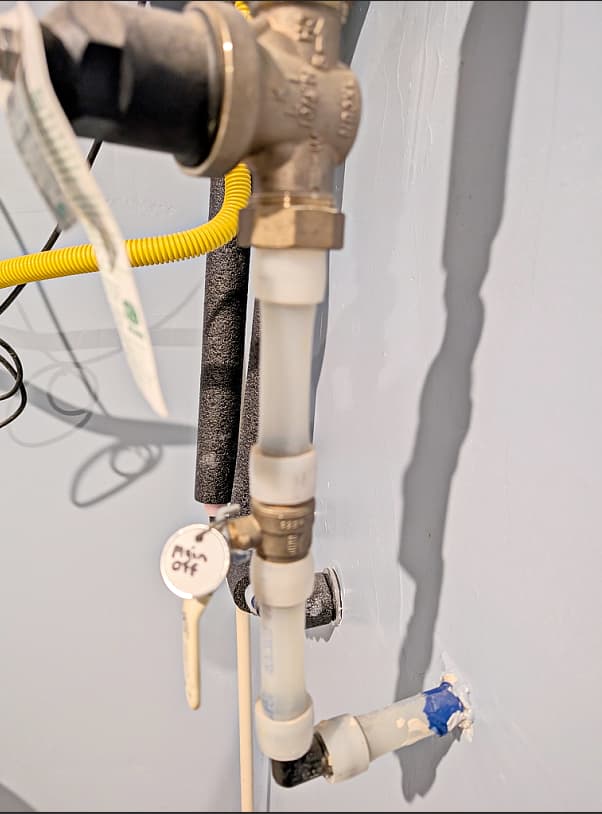
Speaking of CPVC, I just found out that my main water shutoff line is mostly plastic junk. So I'm not inclined to install ANY smart valve shutoff devices. Unless I get this plastic junk replaced.
Update: I was informed by some in this forum that this is not "junk", but rather PEX tubing. I'm having a plumber out tomorrow to give me an estimate to replace the PEX with copper. He said normally he replaces copper with PEX! 
Most homebrew setups would be better quality than that... That said, best to speak to a qualified plumber to get it setup properly with some kind of warranty.
I just bought this house brand new 2 years ago. They don't make them like they used to!
Makes me appreciate the metals we have under our scorched earth down here in Oz...
You have PEX there... PEX (although plastic) is a very different animal from CVPC. Your fittings appear to be Apollo-type expansion ring/sleeves used exclusively with PEX-A, and (IMHO) that's the best possible PEX setup. Most of my house is plumbed that way.
Although we could all debate the quality of how that particular bit of plumbing you pictured is stitched together, the PEX and fittings involved appear to be pretty top-of-the-line.
But PEX-A is the "softest" / most flexible version of PEX, so while that brings some of its own advantages, it is less rigid than other types of PEX. I would not put a bolt-on smart shutoff valve device on any PEX, but for different reasons than CPVC...
CPVC is inherently brittle, so any stresses induced by asymmetric valve actuation could very well just full on shatter the valve or pipe -- that would be a catastrophic failure.
Whereas on PEX, asymmetric valve actuation could lead to fittings loosening as the pipe/fitting get flexed -- although this too could result in catastrophic failure, it more typically would result in leaky fittings over time.
Since PEX's arrival, there's not much CVPC being used these days, but it's still out there.
No matter what smart shutoff valve device you choose, I would always recommend that it goes on a section that's piped with good ol' copper -- copper provides the best rigidity so it's more immune to any twists/flexes that may be induced with asymmetric valve actuation.
Although my house is primarily plumbed with PEX, the area around my main line entering the house and my water heater (the two places I want smart shut-off valves devices) are both plumbed in copper (type K and L).