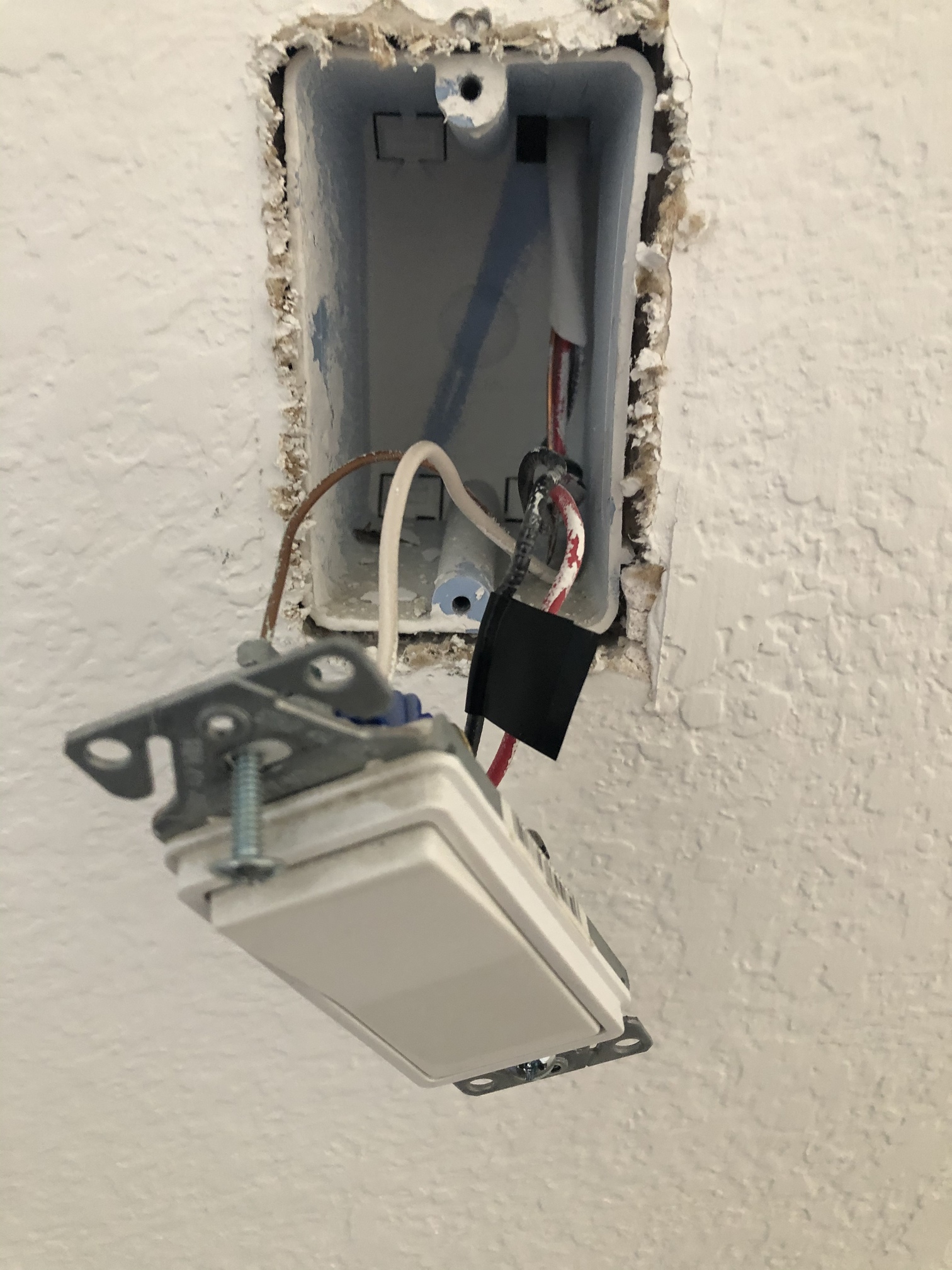
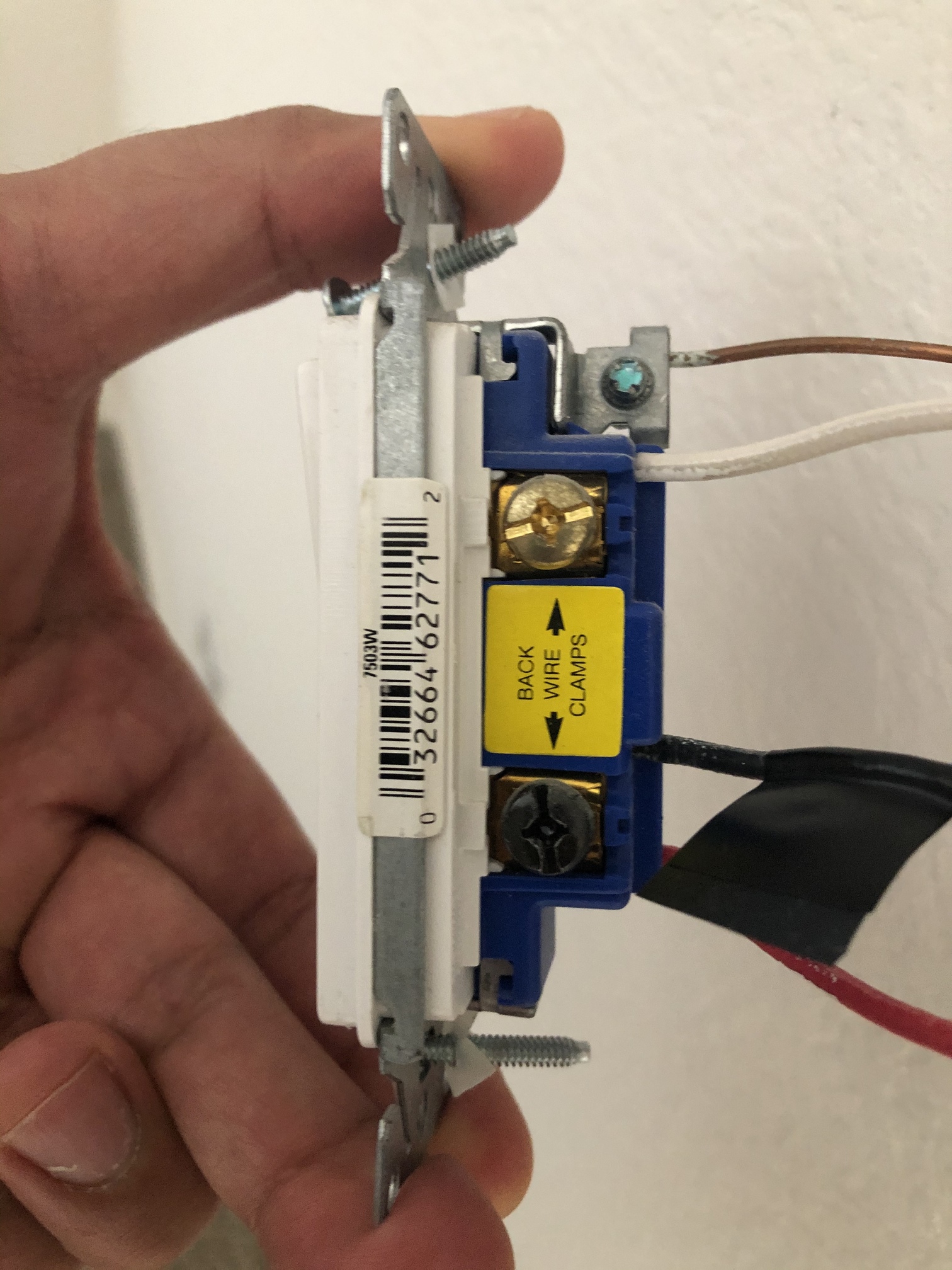
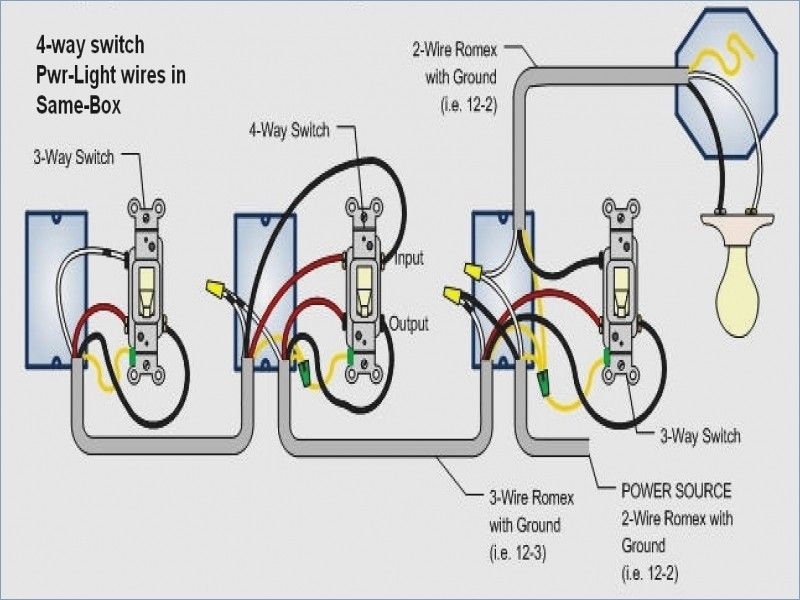
Assuming the black wire is the one you think goes to the load in Box C I am surprised it is showing 90V. You stated red and white were the traveler wires. The black should be nearer 0v if it goes to load and then the load has other side connected to Neutral.
What is the load ? Is it an incandescent (filament) bulb ? If not and it’s an energy bulb could you easily replace it with a known working filament bulb and see if the voltage on the black wire drops to near 0v
It is actually a series of 3 LED bulb. Fwiw, when the light is OFF, I still see dim flickering.
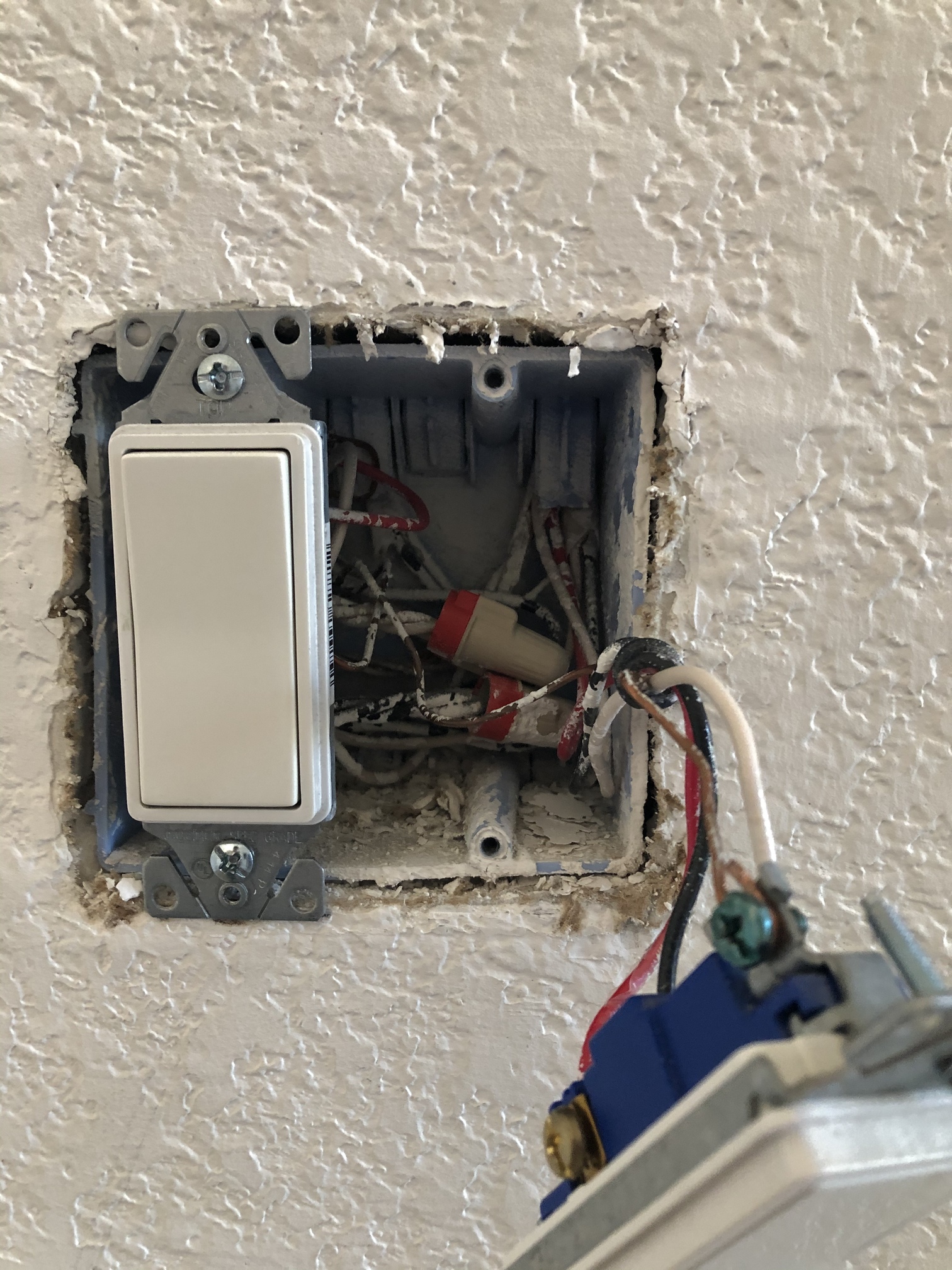
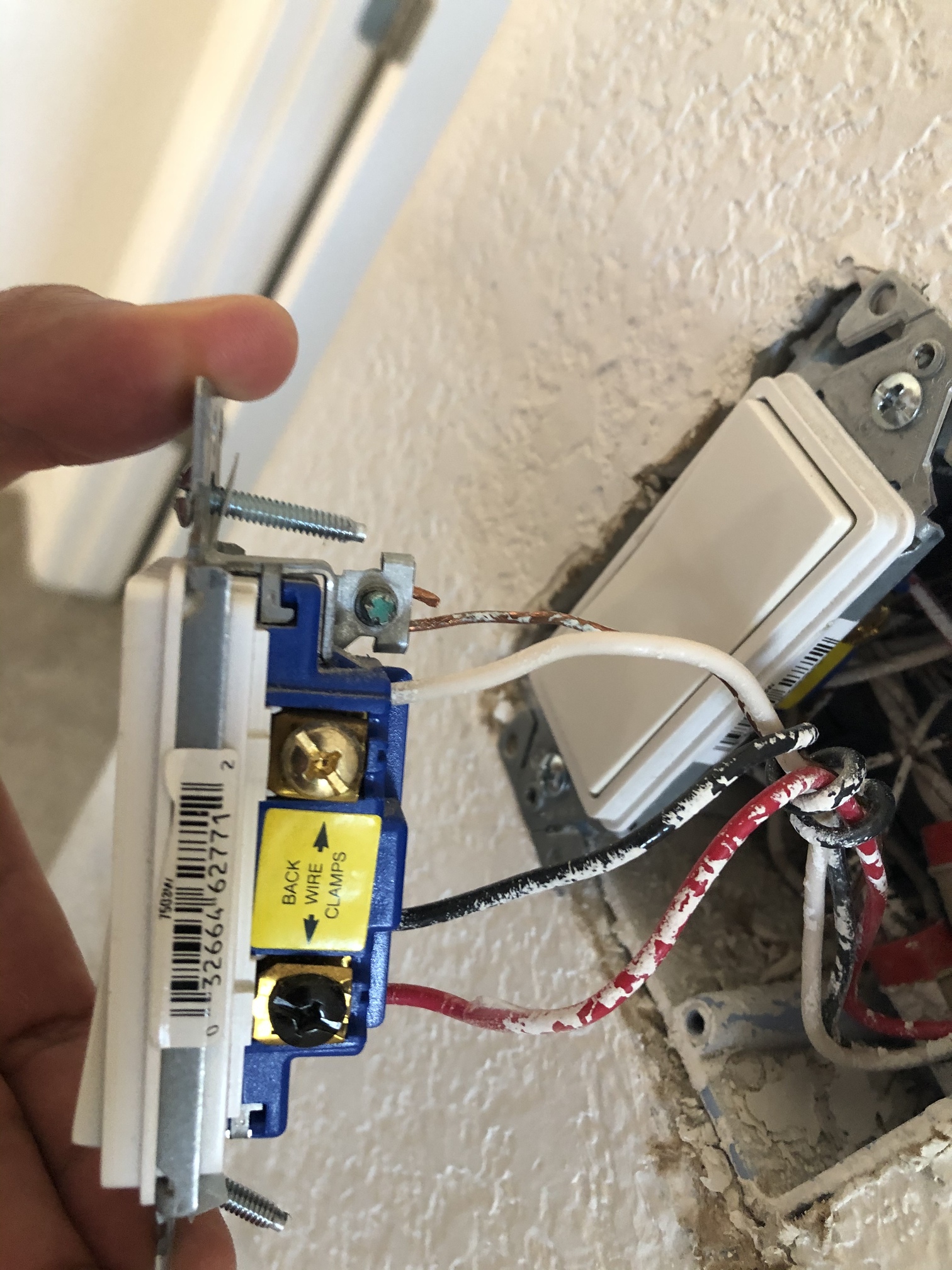
I have to check and be sure again. But from Box A, the 120V line is black, so I assumed the red and white are travelers. In Box C, there is a bundle that connects to the switch, and a bundle with pigtailed white wires. I'm assuming the pigtailed white wires are neutral and the white wire connected to the concerned switch is the common, because it measured 120V when box A switch is connected. I don't know why one of the wires measured 90 V, and the other a low voltage.
Unless you also remove all the light bulbs as well. Otherwise removing all the wiring from the switches might not be enought to find Line.
Take Advice from @ritchierich and pay close attention to the common terminal screws on both 3 ways switches. Those 2 terminals are the most important in the circuit. The rest are just travellers so ignore them.
In all 3/4 ways circuit. The common terminals are the one carrying Line and load. If one is line then the other is Load.
Put your voltmeter lead on one of the common terminal and ground and check for voltage.
When light is on and 120VAC is present and 0 when off. Then that's your Load.
Go to the common screw of the other 3 ways switch and do the same. You should see 120VAC regardless of light on or off. That will be your line.
Once you know Line. Remove all wires from switches and place the lead of your meter on line and the other wire in the same Romex as the line wire. If you have 120VAC. Then that's your neutral. If not then keep searching for 120VAC between line and other white wire for 120VAC.
Thanks for this write up. I'll do this when I get home. From the sound of this. I don’t have to remove the wires from the switch to tell where the line is.
For clarification, when I find the line wire, I will put my lead on the line AND white wire bundled in the same ROMEX cable. If it's 120V then it is the neutral? Thanks.
I'm going to drop out of this as I don't know US wiring color regulations and how enforced they are. That statement above worries me as there should be no source of power currently to the LED lights as all switches are disconnected.
Just as one last clarification - does white red enter Box C and also leave as white/red sheathed in another cable. No other colors?
Ahh - you don't mean now.. you mean previously - do you have any other intelligent switching on those LED's or just the three mechanical switches ? Flickering LED's implies some current leakage (still) through the lighting even when off. This happens with devices trying to derive power (without a N) from the light.
This is true but the 'path' to live has to exist and if you are using only switches it doesn't when off.
With solid state (e.g. intelligent, ZWave, ZigBee or Wifi) switches trying to derive power through the lamp (so they continue to work when lamp is off) they still have a high impedence (leakage) that occurs through the bulb even when off. They draw a tiny current and this can cause flicker. Without any current (or circuit path) there can be no flickering.
Baffled
There is a transformer or controller I assume for the LED's (these are low voltage) - does it possibly have another supply feed with a 'control' input or something ?
I just bought cheap LED lights and replaced my incandescent bulbs with it. There is no transformer. I notice it at night when all our lights are off. The flickering will stop after about 2 hours or so sometimes. I also read that some led lights pick up current from neutral or ground.
So the test that I did mentioned above is this, on Box A black (with electrical tape) to ground is 120 and red to ground is 120 also. When switched, black remains 120 but the red goes to about 90 volts. White wire around 4 volts
Box C, the red wire is 120V, black is around 20V. When switched, both has 120V.
Then I removed Box C red wire with constant 120. Box A still has 120V on black wire. When switched, both black and red has 120V. White wire a constant low voltage.
Then I put Box C red wire back, removed box A black wire (with electrical tape). Box C red wire now reads from 4-20 volts, black wire and white about 1-4 volts.
With this, correct me if I'm wrong, the hot wire is in Box A, the black wire with electrical tape on. Ergo, that is where I should put my smart switch. The problem is there is no neutral wire. After I disconnected everything from Box A, I test line to neutral, but it didn't read 120V. Only 90-100
Did you also look inside the light gang box to see if line from breaker goes to there first?
It common for 3way and 4 ways lines to go to light gang box first then out to switch and yes if you disconnected both switches, it will show hot in the switch gang box coming from the line inside light gang box.
My assumption is the line goes in the Box A first. I disconnected the wires from both Box A and C. The only hot wire there is on box A when I tested the voltage to neutral.
Also, if the line wire is on Box C, it would still read 120V even if I disconnected all the wires in Box A.
Your neutral, Line and Load are in Box C.
The black wire on the common terminal is you Load. That's the reason for the voltage changed when operating the switches.
Look for the white wire in the same Romex as the black load wire. You will most likely see it's connected in a twist-on connector ( Marrette) possible 2 to 3 white wires. One is neutral from the circuit breaker and the other one is the neutral from your light bulb. Maybe a third white from the switch beside this box C 3 ways switch as well. That's your neutral.
Look for a twist-on connector (Marrette) with black wires in box C. Possible 2 to 3 wires. Your line is there.
I can see 2 twist-on connectors on the box c pic.
I believe you have this. Ignore wire colors.
So if this is the case, then why when I disconnected the wires on Box A, I don't get 120V on Box C? When I tested the voltage like to instructed earlier, the constant 120V is the red wire on Box C with switch on Box A connected. But, when disconnected, I don't get 120V reading. I'll recheck again just to make sure.
Look at the diagram. The line wire is in the twist-on connector at box C that was why.
Edit : just in case you are curious about the 90VAC. This is a floating voltage and very common in 3/4 ways circuit when both end of the wire connected to nothing and in the same Romex with a wire with voltage.
Oh fudge, I saw it now. Stupid me, not looking good enough. This is very helpful. Thanks. so basically, the line wire goes in Box C, but does not connect to the switch on Box C, but Box A via white wire. I can confirm that this is the case when I get 120V on the white wire correct?