Phare Smoke/CO sensors...possible Nest Protect replacement option

These look like they could become a good option for replacing in-place Nest Protects as they age out (I have six but mine are good until 2030, so not seriously shopping yet.) Anyone tried them?

Below is a topic on Reddit w/one of the cofounders providing more current info:

The Phare sensors are the only option I've seen so far that includes a type of pathlight feature which a lot of Protect users really seem to like a lot. They don't do voice, unfortunately, but have push notifications/alarms and gradually escalating light/sound on their devices when there is an alarm.

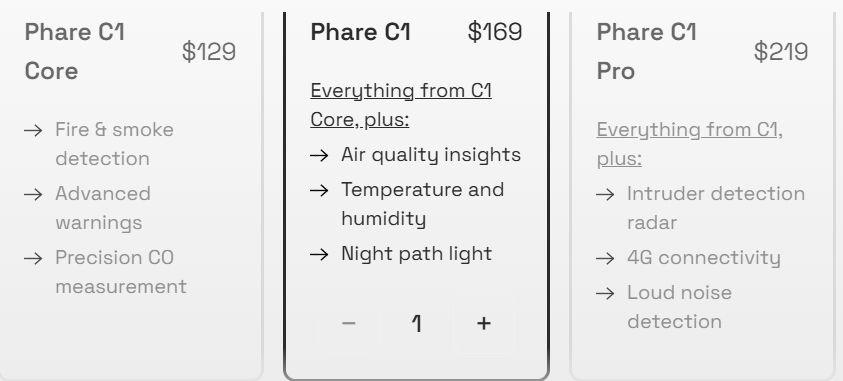
They do have a subscription model but you only need one subscription for any number of Phares in a location. Basic sub is $1.99/mo, 1st year free, "Pro" sub is $7.99/mo. Both subs are optional and you aren't "crippled" if you don't sign up for either. For me $1.99/mo will be a no-brainer.

More info on models & subs:


[/grid]

Anyway, looks like worth a look.

Interesting. Not sure I'd pay the price for these as compared to standard hardwired detectors. I don't need air quality and climate monitoring. I get that with my Ecobee thermostats.

For the Protect Starter subscription, I have to wonder what "Smarter protection with every update" means. If you don't have a subscription, are these just "dumb" detectors? Yes, I know there is an app, etc., but what can they possible be adding with each update? They may be adding features to the app, but the detectors are detectors. The hardware isn't changing. So are they saying each update adds something that the detector doesn't already have? Seems a bit odd to me.

Also, for the Protect Pro subscription, the "Lifetime hardware warranty" seems a bit odd to me as well. Isn't the lifespan of a detector 10 years? So what is the warranty covering that is lifetime? My guess is that they will replace the detector if it fails within its 10 year lifespan. I can't imagine they'd replace your detector/s every 10 years.

so the protect Pro, just figure at the current $7.99 a month for just one year is 95.88, say 10 year lifespan of the unit that's 958.88, and knowing how the cost of making vs what they sell it for they are making them for under $50 each, that's a lot of replacement units they can do before it affects their bottom line. Just another subscription to nickel and dime us to death.

Plusses:

  • Hardware includes a number of sensors (particularly the C1) that are a nice plus.
  • Hardwired, which I prefer to battery units, but this is relatively minor to me.
  • Smoke & CO2, which is good.
  • Fairly simple, clean design. Should not stand out, which is a good way to keep a sensor cluster acceptable.

Negatives:

  • Subscriptions are basically a killer.
  • API requiring subscription.
  • Data unavailable outside of API (or in their app).
  • Updates require an active subscription.
  • Features of the Pro model do not justify the $50 increase for me (do not need/want 4G in it)
  • Likely cloud-only API.

More detailed responses:

  • Subscriptions make it pretty much a "nope" for me. I also find the concept that updates to the device REQUIRE a subscription. So if you let yours expire after the first year, you no longer get firmware updates? That strikes me as a big problem. The API only being available in the Pro subscription means I will never develop for it. :man_shrugging:
  • The fact that the API is only with the higher subscription implies to me (admittedly, I did not do a lot of digging to confirm) that it will only be cloud based. Meaning I cannot just keep the data on my network and directly query the devices once in a while whenever I want Hubitat to check. This is less of an issue than charging for it (I have multiple drivers/devices that rely on cloud APIs) but it is still a negative to me.
  • The price difference between the C1 Core and C1 for the features included is reasonable in my book. $40 for a nightlight, motion sensor, temperature, humidity, and air quality. Tough to find all those in some other device for $40, although it currently appears you would need API access to make use of those with something like Hubitat. So all those sensors/data are pretty much useless to me (which I HATED about the Nest Protect I used to have, and liked about the Halos I had). The Pro, at an additional $50 over the C1 adds intruder detection radar (? difference over motion detection in C1), loud noise detection (OK), and 4G (nope). So not really justifying that additional cost. 4G is expected to start phasing out in the late 2030s, so about 10-14 years (with some carriers planning on cutting aspects earlier). I would expect them to replace that modem chip before then in a future design...

In the smart smoke detector marketplace, there have been more companies that have gone out of business than those who have managed to stay afloat.

So a cloud/subscription model is a hard no for me.

Agree regarding the $7.99 sub & its extra features....that's a fool's path.

However, in regards to the $1.99 sub (call it the FW update sub) the result of them going out of biz is pretty much exactly the same as if a non-cloud/non sub company went out of biz. If either type of company fails you no longer get FW updates/support, but the device still works and provides the core functionality available before the company failed, i.e., smoke/CO sensing/reporting works, no cloud required).

So I'd just treat the cost of the "FW update" annual sub as a part of the real cost of the device, e.g., I would need six sensors, and if I assume they last 10 years, then ((12x1.99)/6)x10=$39.8 gives me the requried add-on cost of the sub per sensor. So for the C1 Core (the only model I'm interested in) my "real" purchase price is $129+$40=$169. Then do the normal ROI/compare to other brands (including best guess as likelihood of survival) and decide if it's worth it.

BTW...there is another that looks interesting that I ran into recently, and it has voice, which my family really wants... :slight_smile: Don't think this has any home automation connections so would need to pair alarm listening devices with it.

Siterlink Hardwired Smoke Detector and Carbon Monoxide Detector 1 Pack

Ask yourself this. What do these high priced detectors really get you that a regular hardwired detector doesn't? An app? Air quality monitoring? I can get that at a lower cost via other devices, in addition to being able to make my dumb hardwired detectors smart by adding a relay. Smoke and carbon monoxide detectors are safety items. They should be nothing more and nothing less. Do you really want and/or need all the extra bells and whistles in a device meant to possibly save your life? I certainly don't. Please don't take my comments the wrong way. I just hate hearing of people spending money on over priced safety related items.

I don't see the value in these Phare, or other detectors. The price isn't justifiable, to me, for what I consider a throw away device. Yes, it should last 10 years, but what if it doesn't? Without the higher end subscription, you're stuck throwing more money at a new device with the hopes that it survives the next 10 years.

My smoke detectors don't need a firmware update :grinning_face:

I used to have to First Alert detectors, and I don't remember needing to update the firmware on those either.

And a Zooz Zen55 works well enough to bring them into Hubitat.

Just to be clear, I'm not saying they are a good deal/good idea to buy, I'm just jawing for the fun of it about the decision process (up near 100 again today so stuck indoors & a bit bored). LIke I said at the start, I don't have a dog in this hunt, I'm years out from any new smoke detectors. :slight_smile: Oops, and forgot, my family really wants sensors w/voice like the Nest, so these wouldn't even make the first cut in our house. :wink:

I’m getting old. A few years ago, I’d have been gung-ho about everything being “smart”. I’m way more picky now, and grumpy along the way …..

You’ll find me under curmudgeon in the dictionary.

:grin:

Def grok that... :wink:

I agree with this except you don’t get the info on which sensor has tripped the alarm.

Ahh, thanks for this info, I hadn't looked at the details on these so I wasn't aware you don't get sensor location from them.

The reason I originally was interested in smart smoke detectors was because of the extra sensors/notification possibilities. My family does not want to see a bunch of sensors around reading the temperature, monitoring their motion, etc... but they like the outcome of some of it (as long as it is all hidden behind the scenes).

Nest Protect had a lot of sensors... but made it tough to get access to them. Tried one early on, found it too constrained. The Halo detectors made accessing data much easier (but no motion) and were local only, got a few of them.

So I was able to replace most of the normal smoke detectors with Halo, and some of the other sensors. Family just saw smoke detectors in smoke detector spots. Completely ignored, not even within notice. But they provided those temperature and humidity (pressure not so relevant) readings readily. Plus, they had an LED ring built in. This allowed me to have them act as a nightlight in some spots or change the color and brightness for notifications (smoke detectors are glowing bright blue, there is a water leak with my aquarium was one).

So in reality, it is not so much about having a smoke/co detector that connects to Hubitat. It is about an inconspicuous multi-sensor (and notification) package that will be completely ignored until needed. Smoke detectors fit a critical but ignored niche for homes. But the number of people that are willing to buy SMART ones is low.

It boils down to a few things (IMO):

How many people are into home automation enough that they want those sensor systems? A fair number, or else the general industry would not be surviving.

Will they find out about them and purchase them? Tougher, because we all have seen these scenarios fail already.

Is that sustainable enough (with corporate greed) that limited market only replacing them every 10 years or so? Probably not. Not unless they can bring their costs down a lot or find regular other income, which boils down to a subscription for some services and/or selling the data the devices generate (if they send it back at all).

With the simple devices, is the extra cost per connected smoke detector vs a simple relay-based sensor that can take care of a whole system's notification worth it? Probably not.

Does it really matter in an emergency situation?

YMMV, but for me, being able to determine the source of the alarm is a big plus. I want to be able to immediately go to the source and determine if it is real or a false alarm. I wouldn't want to have to go through the house room-by-room looking for the source while a small smoldering fire is becoming a big fire.

An activation from the alarm closest to the kitchen while making dinner is going to concern me a bit less than one from the utility room in the basement at the same time. While I haven't had too many false alarms in the past, I have had some. If I'm home and can investigate the cause, I'm not evacuating and calling the fire department just because an alarm activates.

p.s. On a tangent, if you have smart detectors and smart locks, create an automation to unlock the doors when an alarm occurs. It might save you the cost of a new door by letting the FD in without bashing through the door.

@Alan_F has answered for me.

If the intent is just to GET OUT, I agree it does not matter.

but if I am woken up in the middle of the night and it’s not apparent, I would really like to know of I’m going upstairs or downstairs to check things out.

I think the other recommendation in the event of a fire is to turn off HVAC as well. Don't want to spread smoke/gasses, feed the fire, etc.

This for me as well. Depending on the house size/layout and where family members sleep it might also affect route chosen to get out if it is a serious situation.

IMHO, yes. When my attic fan went up in smoke I knew immediately to cut the power and didn't run all over 3 floors looking for smoke/fire and was able to avoid a huge disaster, rapidly.

