I just wanted to pop in to thank the developers for this incredibly powerful and reliable driver! I’ve been using this for a long time to integrate my ceiling fans, various TVs, electric candles that had IR remotes, some old school IR light strips, my gas fireplace, and many others into Hubitat. The “learn RF” and “learn IR” functions are dead simple and reliable. Also the fact that this works locally is even more amazing!
So thank you for the countless hours put into this amazing driver. I can’t imagine my Hubitat system without it!
I acquired A Broadlink RM4 to solve a theater room powerup/powerdown sequencing problem that an old Harmony hub was handling. New equipment was installed, and the Harmony is no longer supported by Logitech. The remotes for the new equipment all put out I/R toggle HEX codes to power up and down. I've secured the discrete on/off Hex codes for I/R values for the new equipment and I read that the RM4, with the @tomw Broadlink driver, along with my Hubitat C-8 could allow for a resolution. I installed all the above, pressed learnIR, hit the first remotes On/Off. Then looked for the lastCode attribute described in the README.md from the tomw GitHub space. It absent from the driver page and not found as an attribute by Rule Machine. And no other attribute on the page was populated with the learned code, nor was any attribute found to be populated in a condition that I have in a Rule Machine test rule. I loaded the Driver Code into Notepad++ and found no lastCode attribute defined. The driver version I downloaded states "0.9.9". I could probably stumble through (I'm new to groovy) adding the attribute so I can modify the I/R Hex value before saving. But wouldn't want to be depending on an unsupported version, having used HPM to install it. What am I missing?
It's been awhile since I set mine up. But it seems like you need to save the learned code. Then you will see the saved IR sting listed in under the state variables for the Broadlink device you created. You can then send that saved learned code by the name you give it. I never used lastCode attribute
OK, I clicked 'Save Learned Code', an attribute appeared in the 'Current States' section of the device page named 'savedCode' which reads {button=null}. I know the the code that the button puts out as I have an I/R decoder, its the pwr toggle, I want to change the code to discrete on or off before saving. Or I could change change it after its saved, if I find that I have access to it where it is saved. Since the value is null, I guess it did not capture a code. When I pressed 'Learn IR', the RM4 led lit up red, I pressed the remote button, the led turned off, at that time i assumed a code was captured. I don't really like to use chinese apps, kinda hated that I had to create a login on a system in China just to get the RM4 to connect to WiFi. But I might have to toy with the Chinese app in attempt to discover how the RM4 works, if it strores codes or the app stores them in chinese cloud systems. Then try to decipher the driver code to see if I can make it usable.
I can't really remember what happened when I saved the code. I think it was just point the remote at the RM4 hit LearnIR, then Save Learned code and assign it a name. As I mentioned it was over a year ago since I set it up. I am not using any third party app. In fact from what I recall you can't get data from the app into the HE driver. If you look back through this thread it seemed like I asked about that.
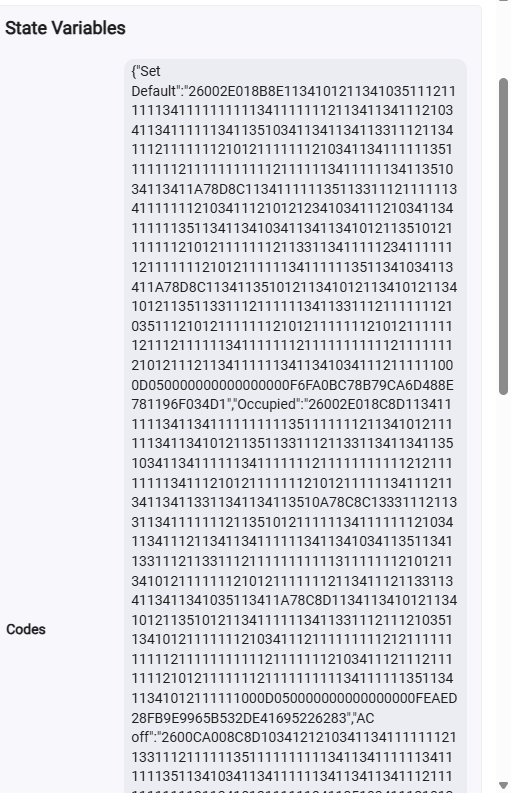
The code should appear as a text string. You can copy those strings and edit or save them in a text file for backup. Here is a screenshot of the state variable listing from the a device I created to control my AC unit in my shop office. You can see the IR code with the corresponding names for a couple of setups I made.
[edit]Search this thread for my user name, you might find those post helpful. I asked a number of questions that are similar to what you are asking now.
Well I have deleted and re-installed via HPM and Manual, several iterations. Results are always the same, two things appear to work, Learn IR lights the RM4 light(red). Press a remote button, the light goes out.
But the learned code is nowhere to be found in any place in the groovy driver code. Which explains why Test Learned Code does nothing (monitored with an IR decoder) and Save Learned Code returns savedCode {code1=null}. I also have found "advertised" pronto format codes for most devices that I need. I also read the driver can translate pronto and irlc codes. But there is no way to stimulate or input a code to translate. I do find defined methods(or functions) for those imports in the broadlinkHelpers.groovy file, along with other methods(def's), which HPM placed in the Libraries section. None of the functions or methods(i'm not a groovy expert) in that file are found anywhere in the device pages.
In the beginning of my bumbling-about, I also installed the rumored required Python environment (Windows 11 box), I can run and interact with it, so I assume if it is required, its here and functional. Launcher dir is in my PATH. (Limited Python knowledge from way back Posix System 5 compliant Unix sysadmin duties(15 to 20 years ago).
I could assume there is a step or two left out of the install instructs, yet an HPM install yields the same results. So I'm at full stop until I learn how to debug a non-functioning driver.
Is your RM4 registered and does it still show up in the Broadlink mobile app? I learned the hard way that if you remove the RM4 from the Broadlink mobile app, it will remain connected to your WiFi network, but will not work.
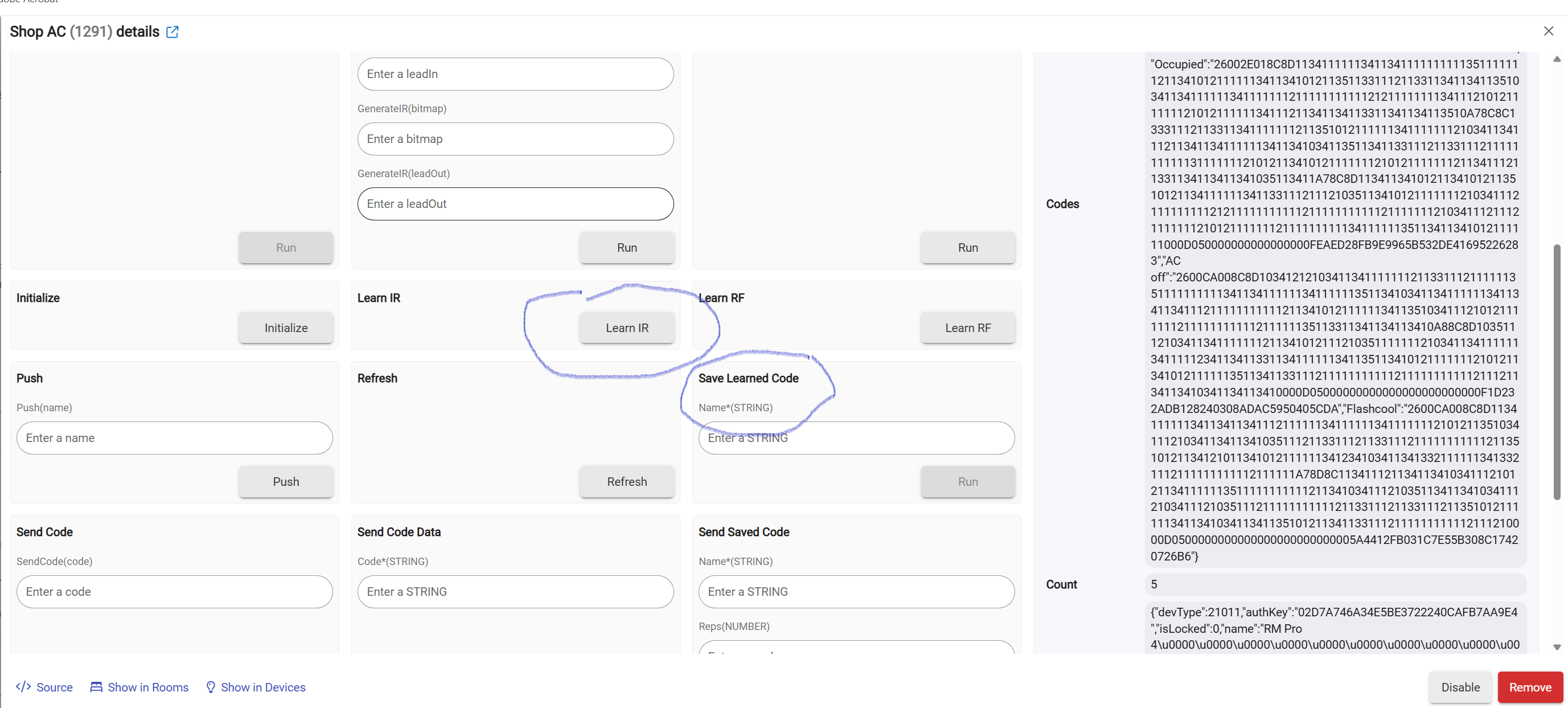
You need to create a virtual device and then set the device to use the Broadlink remote driver. Then use the two buttons on the commands page, circled below, to learn your code. I think I tried to do the same thing the first time I tried setting this up.
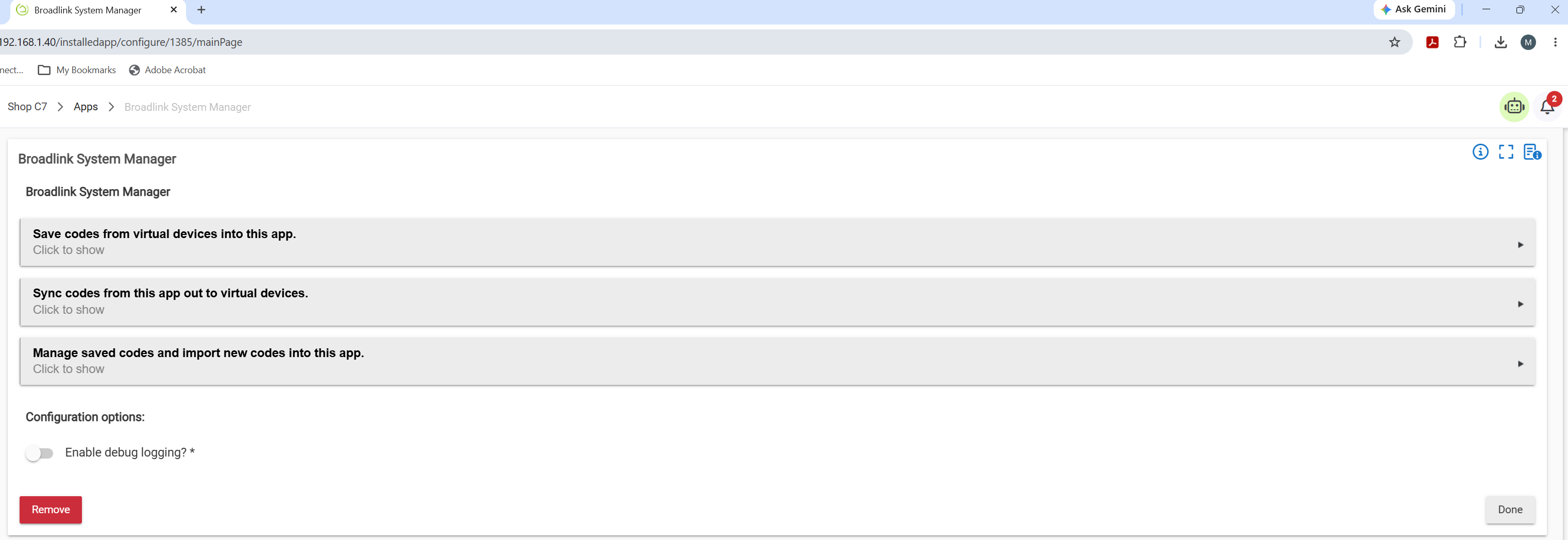
Well I don't have a system manager, I read that app was for multiple broadlinks.
Yes, I am clicking Learn IR, then Save Learned Code.
I wondered if the RM4 was defective and could not learn a code. Until this, the only use of the BL chinese app was to get the unit connected to wifi. So I fired up the chinese app and set it to learn a code, the red light came on, I pushed a button on the remote, the light went off, the app said success, i tested the code, the IR decoder I have confirmed the hex values I was expecting, i named the learned button and flipped off the chinese app.
So the unit can work.
I was revisiting the tomw github area and I noticed BroadlinkRemote had a 0.9.10 revision that was 3 years old but appeared not to be in a finished form, ready for download, like the 0.9.9 version that HPM brought in. I'm new to github as my software experience was gained while employed by a defense contractor, and public code was never acceptable. Infact java and the scripting languages that accompany it were strictly forbidden as it was easily hackable. By 2010, java had been hardened, sort of, then I retired in 2011. So i don't know what to think of the 0.9.10 revision on github.
And, as time permits, I will re-read/scan this topic for possible solutions.
yes, thanks @Ranchitat, been there, tried that, deleted the device, toggled locked, added, deleted device, locked, then added, unlocked while added, and.....
In the devDetails array(if thats what it is called in groovy, geeez i need to find groovy manual, maybe groovy for dummies) the isLocked info pair follows the locked status as shown in the BL app. That is, unlocked=,"isLocked":0, locked=,"isLocked":1,.
The Initialize(), works. Two problems, I cannot learn a code and I cannot figure out how to stimulate a Pronto translation. ( The remotes all put out 'toggle' for power, I want to change them to discrete on/off after learning the toggle, then save with the hex on and off values. also I think I have the pronto codes for several that I need to learn. but cannot find import pronto command, its in the "Helper" library, but I cannot execute it)
I went with this for my solution because of all the successes i read about. So I'm sure i am just not doing the right thing(s). And following instructions always results in the same outcome.
I've come to the conclusion that I must learn how to insert debug code in the driver and analyze the commands and responses to find out the one thing I'm missing.
Ok.....I'm stuck here. Just bot an RM4 mini. It is installed in the Broadlink app. The Lock status is set to "Off" (unlocked). I even installed a sub device for my mini split and from the Broadlink app, I can fully control the mini split.
I installed the app/driver via HPM.
I created a virtual device and use the "Broadlink Remote" as the driver.
In the prefrences tab, I do enter the IP and save.
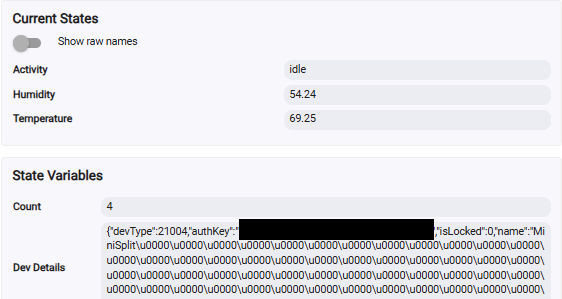
In commands I click Initialize and Refresh with below results. Clearly HE sees and is talking to the device. (I have the special power cable, so the Temp and Hudity is expected)
Tomw sent me a DM with the following link....worked successfully for me.
For those that are less code savy like me....took a little bit of time to decifer how to implement the changes. For a full Driver code replacment with the tweaks mentioned in this post, you can use the below code:
/*

Copyright 2022 - tomw

Licensed under the Apache License, Version 2.0 (the "License");
you may not use this file except in compliance with the License.
You may obtain a copy of the License at

http://www.apache.org/licenses/LICENSE-2.0

Unless required by applicable law or agreed to in writing, software
distributed under the License is distributed on an "AS IS" BASIS,
WITHOUT WARRANTIES OR CONDITIONS OF ANY KIND, either express or implied.
See the License for the specific language governing permissions and
limitations under the License.


Change history:

0.9.9 - tomw - Make device keep-alive ping a configurable option, and disable by default for RM4 devices.
0.9.8 - tomw - Fix for IllegalBlockSizeException.
0.9.7 - tomw - Support for sensors (temperature and humidity).
0.9.6 - tomw - Bugfixes and improved error reporting.
0.9.5 - tomw - Added ping for RM3 devices as keep-alive.
0.9.4 - tomw - Added 'sequence' scripting feature.
0.9.3 - tomw - Rework app UI to use buttons.
0.9.1 - tomw - Added push command, which uses the button name as a saved code to send.
0.9.0 - tomw - Initial release.

*/

metadata
{
definition(name: "Broadlink Remote", namespace: "tomw", author: "tomw",
importUrl: "https://raw.githubusercontent.com/tomwpublic/hubitat_broadlink/main/broadlinkRemoteDriver")
{
capability "Actuator"
capability "Initialize"
capability "RelativeHumidityMeasurement"
capability "Refresh"
capability "TemperatureMeasurement"

    command "learnIR"

    command "cancelRF"
    command "learnRF"
    command "sweepRF"

    command "sendCodeData", [[name: "code*", type: "STRING"]]
    command "push", ["name"]

    command "clearSavedCodes"
    command "deleteSavedCode", [[name: "name*", type: "STRING"]]
    command "saveLearnedCode", [[name: "name*", type: "STRING"]]
    command "testLearnedCode"
    command "sendSavedCode", [[name: "name*", type: "STRING"], [name: "reps", type: "NUMBER"]]

    command "cacheCodesForApp", ["retain"]

    // compatibility for previous integration
    command "importCodes", ["codeStore"]
    command "SendStoredCode", [[name: "name*", type: "STRING"], [name: "reps", type: "NUMBER"]]
    command "SendCode", ["code"]
    command "generateIR", ["offBurst", "onBurst", "leadIn", "bitmap", "leadOut"]
    // compatibility for previous integration

    attribute "learnedCode", "string"
    attribute "savedCode", "string"

    attribute "activity", "string"

    // enable to decode pcap trace
    //command "prepResponse", ["resp"]
}

}

preferences
{
section
{
input name: "ipAddress", type: "text", title: "IP address", required: true
input name: "deviceHasRF", type: "bool", title: "Does your device support RF?", defaultValue: false
input name: "doDevicePing", type: "bool", title: "Send keep-alive ping to RM3 and RM Pro devices?", defaultValue: true
}
section
{
input name: "logEnable", type: "bool", title: "Enable debug logging", defaultValue: true
}
}

import groovy.transform.Field

@Field INIT_KEY = "097628343fe99e23765c1513accf8b02"
@Field INIT_VECT = "562e17996d093d28ddb3ba695a2e6f58"

@Field cmdAuthReq = 0x65
@Field cmdControl = 0x6A

// common payloads that don't change
@Field byte
 getFwVers       = [0x68]
@Field byte
 checkSensors    = [0x01]
@Field byte
 checkSensors4   = [0x24]

import hubitat.device.HubAction
import hubitat.device.Protocol
import hubitat.helper.HexUtils

def logDebug(msg)
{
if (logEnable)
{
log.debug(msg)
}
}

def initialize()
{
unschedule()

// clear these code values, in case the long strings cause browser problems
device.deleteCurrentState("learnedCode")
device.deleteCurrentState("savedCode")

scan()

}

def updated()
{
initialize()
}

def cancelAll()
{
causeWaitCancel()
}

def scan()
{
// always cancel and try to re-init on scan()
cancelAll()
updateDevStatus("initializing")

// https://github.com/mjg59/python-broadlink/blob/master/protocol.md#network-discovery
byte[] packet = [0] * 48
packet[0x26] = 6

def cs = calcChecksum(packet)
packet = replaceSubArr(packet, cs, 0x20)

def str = HexUtils.byteArrayToHexString(packet)

def params = [type: HubAction.Type.LAN_TYPE_UDPCLIENT, destinationAddress: ipAddress, encoding: HubAction.Encoding.HEX_STRING, callback: "scanResponse"]

def hubAction = new HubAction(str, Protocol.LAN, params)
sendHubCommand(hubAction)

}

def scanResponse(message)
{
def lanMsg = parseLanMessage(message)
//logDebug("parse: ${lanMsg}")
def plb = HexUtils.hexStringToByteArray(lanMsg.payload)
logDebug("scanResp = ${HexUtils.byteArrayToHexString(plb)}")

def devType = bytesToInt(subBytes(plb, 0x34, 2), "little")
def mac = HexUtils.byteArrayToHexString(reverseBytes(subBytes(plb, 0x3A, 6)))
def name = new String(subBytes(plb, 0x40, plb.size() - 0x40))
def isLocked = plb[0x7F]

def devDetails = [devType: devType, mac: mac, name: name, isLocked: isLocked, id: 0, authKey: INIT_KEY]
setDevDetails(devDetails)

if(isLocked)
{
    updateDevStatus("device is locked in Broadlink app")
    return
}

pauseExecution(500)

// need to auth this device
auth()
updateDevStatus("waiting for auth", false)

}

def setDevDetails(devDetails) { state.devDetails = devDetails }

def getDevDetails() { return state.devDetails ?: [:]}

def updateDevStatus(activity, readyForAction = true)
{
sendEvent(name: "activity", value: activity)
setVolatileState("readyForAction", readyForAction)
}

def checkReady()
{
def rfA = getVolatileState("readyForAction")
if(null == rfA)
{
// not initialized, so assume "ready"
return true
}

return rfA

}

def updateSeqStatus(inSeq = false)
{
logDebug("updateSeqStatus = ${inSeq}")
setVolatileState("seqExecuting", inSeq)
}

def checkSeqStatus()
{
def sS = getVolatileState("seqExecuting")
if(null == sS)
{
// not initialized, so assume "ready"
return false
}

return sS

}

def auth()
{
if(!checkReady()) { return }

byte[] authPacket = [0] * 80

// https://github.com/mjg59/python-broadlink/blob/master/broadlink/device.py#L173
authPacket[0x1E] = 1
authPacket[0x2D] = 1

// clear message count since we are re-auth'ing
clrCount()

send_packet(getDevDetails() << [callback: "authResponse"], cmdAuthReq, authPacket)

}

def authResponse(message)
{
def resp = prepResponse(message, false, true)
if(null == resp) { return }

logDebug("authResp = ${HexUtils.byteArrayToHexString(resp)}")

// update device id and authKey
def id = bytesToInt(subBytes(resp, 0, 4), "little")
def authKey = HexUtils.byteArrayToHexString(subBytes(resp, 4, 16))
getDevDetails() << [id: id, authKey: authKey]

updateDevStatus("idle")

// kick off ping() loop as keep-alive
if(doDevicePing || (null == doDevicePing))
{
    if(null == doDevicePing)
    {
        // no setting was specified, so this must be someone who upgraded source code
        //  so, make sure the default value is used at least once
        device.updateSetting("doDevicePing", true)
    }

    runIn(60, ping)
}

// try to check basic info
interrogateDevice()

}

def senseAPI()
{
def knownOldDevs =
[0x2737,0x278F,0x27C2,0x27C7,0x27CC,0x27CD,0x27D0,0x27D1,0x27D3,0x27DC,0x27DE,
0x2712,0x272A,0x273D,0x277C,0x2783,0x2787,0x278B,0x2797,0x279D,0x27A1,0x27A6,
0x27A9,0x27C3]

if(knownOldDevs.contains(getDevDetails()?.devType))
{
    // check against known list first
    setNewApi(false)
    return
}

// otherwise, try new API by default
setNewApi(true)
pauseExecution(500)

send_packet(getDevDetails() << [callback: "senseResponse"], cmdControl, [0x01] as byte[])

}

def senseResponse(message)
{
def resp = prepResponse(message, false, true)

if([] == resp)
{
    if(isNewApi() == true)
    {
        log.debug "unmatched old API device: ${getDevDetails()?.devType}"
        setNewApi(false)
        setErrors(0)
    }

    return
}

// if we got this far, new API is confirmed
//  so, disable ping()
device.updateSetting("doDevicePing", false)

// second way of getting device name
//logDebug(new String(subBytes(resp, 0x48, resp.size() - 0x48)))
//logDebug(resp.size())

// second way of getting lock status
//logDebug(resp[0x87])

}

def interrogateDevice()
{
if(!checkReady()) { return }

// get_fwversion
send_packet(getDevDetails() << [callback: "interrogateResp"], cmdControl, getFwVers)

}

def refresh()
{
if(!checkReady()) { return }

// checkSensors
send_packet(getDevDetails() << [callback: "sensorResponse"], cmdControl, isNewApi() ? checkSensors4 : checkSensors)

}

def sensorResponse(message)
{
def resp = prepResponse(message)
if(resp?.size() == 0) { return }

logDebug("sensorResp = ${HexUtils.byteArrayToHexString(resp)}")

def temperature = resp[0] + (resp[1] / 100)
if(temperature)
{
    temperature = convertTemperatureIfNeeded(temperature, "C", 2)
    sendEvent(name: "temperature", value: temperature)
}

def humidity = resp[2] + (resp[3] / 100)
if(humidity)
{
    sendEvent(name: "humidity", value: humidity)
}

}

def interrogateResp(message)
{
def resp = prepResponse(message, false, true)
if(resp?.size() == 0) { return }

//logDebug("interrogateResp = ${HexUtils.byteArrayToHexString(resp)}")

switch(resp[0])
{
    case getFwVers[0]:
        logDebug("get_fwversion: ${bytesToInt(subBytes(resp, 4, 2), "little")}")
        break
    default:
        logDebug resp
}

// try to determine which API version the device speaks
senseAPI()

}

def ping()
{
// send heartbeat ping that would normally come from cloud
//  so that offline devices don't periodically reboot

byte[] packet = [0] * 0x30
packet[0x26] = 1

def params = [type: HubAction.Type.LAN_TYPE_UDPCLIENT, destinationAddress: ipAddress, encoding: HubAction.Encoding.HEX_STRING]
sendHubCommand(new HubAction(HexUtils.byteArrayToHexString(packet), Protocol.LAN, params))

if(doDevicePing) { runIn(60, ping) }

}

def learnIR()
{
if(!checkReady()) { return }

// https://github.com/mjg59/python-broadlink/blob/master/protocol.md#entering-learning-mode
updateDevStatus("learning IR", false)

send_packet(getDevDetails() << [callback: "learnResponse"], cmdControl, [0x03] as byte[])

}

def learnResponse(message)
{
prepResponse(message)

if(!checkError())
{
    // initialize a counter for the readback
    setVolatileState("iter", 0)
    readback()
}

}

def readback()
{
// https://github.com/mjg59/python-broadlink/blob/master/protocol.md#entering-learning-mode
send_packet(getDevDetails() << [callback: "readbackResponse"], cmdControl, [0x04] as byte
)
}

def readbackResponse(message)
{
waitForResponse(message, "readback", "processCodeResp", 40)
}

def processCodeResp(resp)
{
if(resp instanceof List) { resp = resp[0] }
def code = HexUtils.byteArrayToHexString(resp)
//logDebug ("raw code = ${code}")

sendEvent(name: "learnedCode", value: code)
updateDevStatus("code captured")

}

def testLearnedCode()
{
sendCodeData(device.currentValue("learnedCode"))
}

//////////////////////////////////////
// RF state machine
//////////////////////////////////////

@Field byte
 startSweep  = [0x19]
@Field byte
 checkSweep  = [0x1A]
@Field byte
 cancelSweep = [0x1E]
@Field byte
 rfLearn     = [0x1B]

def hasRF()
{
if(!deviceHasRF)
{
log.info "RF command ignored.  Check device preference setting."
}

return deviceHasRF

}

def cancelRF()
{
if(!hasRF()) { return }

cancel_sweep()

}

def learnRF()
{
if(!checkReady()) { return }
if(!hasRF()) { return }

rf_learn()

}

def sweepRF()
{
if(!checkReady()) { return }
if(!hasRF()) { return }

start_sweep()

}

def setTargetRF(freq)
{
if(!hasRF()) { return }

freq = freq?.toFloat()
if(!freq) { return }

if(freq < 300 || freq > 450) { return }

// user input expected in terms of MHz
//   but stored in sweepFreq in terms of kHz
freq = (freq * 1000)?.toInteger()
if(freq) { getDevDetails() << [sweepFreq: freq] }

}

def start_sweep()
{
setVolatileState("iter", 0)

send_packet(getDevDetails() << [callback: "parseRF"], cmdControl, startSweep)
updateDevStatus("sweeping frequency - press and HOLD remote", false)

}

def check_sweep()
{
send_packet(getDevDetails() << [callback: "parseRF"], cmdControl, checkSweep)
}

def cancel_sweep(resp = null)
{
def msg = "trying to cancel RF sweep..."

causeWaitCancel()

updateDevStatus(msg, false)
send_packet(getDevDetails() << [callback: "parseRF"], cmdControl, cancelSweep)
updateDevStatus(msg, true)

}

def rf_learn(resp = null)
{
if(null == getDevDetails()?.sweepFreq)
{
updateDevStatus("missing sweep frequency - be sure to run sweepRF first")
return
}

updateDevStatus("learning RF - press and release button multiple times", false)

byte[] learnCmd = appendByteArr(rfLearn, HexUtils.hexStringToByteArray("00000000000000000000000000"))
byte[] freqTerm = subBytes(intToBytes(getDevDetails()?.sweepFreq, 4, "little"), 0, 3)
learnCmd = replaceSubArr(learnCmd, freqTerm, 4)

send_packet(getDevDetails() << [callback: "parseRF"], cmdControl, learnCmd)

}

def parseRF(message)
{
def resp = prepResponse(message, false)
if(null == resp) { return }

logDebug("parseRF resp = ${HexUtils.byteArrayToHexString(resp)}")

switch(resp[0])
{
    case startSweep[0]:
        if(checkError()) { return }
        // we started sweeping, so start checking for a success response
        check_sweep()
        break

    case checkSweep[0]:
        // sweeping RF; wait for flag to clear in checkSweepResponse
        waitForResponse(message, "check_sweep", "sweepSuccess", 40, "checkSweepResponse")
        break

    case cancelSweep[0]:
        if(checkError()) { return }
        updateDevStatus("cancelled RF sweep")
        break

    case rfLearn[0]:
        setVolatileState("iter", 0)
        readback()
        break
}

}

def sweepSuccess(resp)
{
if(resp instanceof List) { resp = resp[0] }
def sweepFreq = bytesToInt(subBytes(resp, 1, 3), "little")

def msg = "sweep successful: freq = ${sweepFreq}"

logDebug(msg)
getDevDetails() << [sweepFreq: sweepFreq]

updateDevStatus(msg)

}

def checkSweepResponse(resp)
{
if(resp instanceof List) { resp = resp[0] }
// flag is set when sweep was successful
return (resp?.getAt(0) == 1)
}

//////////////////////////////////////
// RF state machine
//////////////////////////////////////

def causeWaitCancel()
{
setVolatileState("iter", 0xFFFF)
}

def waitForResponse(message, retryHandler, successHandler, timeout = 10, addlCheckLogic = null)
{
def resp = prepResponse(message)
def iter = getVolatileState("iter")

// if we timed out, we're done done
if(iter >= timeout)
{
    updateDevStatus("timed out")
    return
}

try
{
    // if the transfer had an error
    if(checkError()) { throw new Exception("errored") }

    // if our additional check was specified AND failed
    if(null != addlCheckLogic)
    {
        if(!"$addlCheckLogic"([resp])) { throw new Exception("check failed") }
    }

    // otherwise, success!
    "$successHandler"([resp])
    return
}
catch(e)
{
    //logDebug e.message

    // try again in 1/2 second
    setVolatileState("iter", iter + 1)
    pauseExecution(500)
    "$retryHandler"()
}

}

def sendCodeData(code, reps = 1)
{
if(!checkReady()) { return }
if(!code)
{
logDebug("sendCodeData() error: no code supplied")
return
}

byte[] sendPacket = [0x02] + [0] * 3

def cb = HexUtils.hexStringToByteArray(code)
sendPacket = appendByteArr(sendPacket, cb)

if(sendPacket[4] == 0x26)
{
    // FOR IR ONLY (0x26 first byte of command),
    //   code will be sent (n+1) times this value
    reps = reps.toInteger()
    reps--
    sendPacket[5] = (reps < 0) ? 0 : reps
}
else
{
    // if this isn't an IR command AND we don't have RF, bail
    if(!hasRF()) { return }
}

logDebug("sendCodeData() packet: ${HexUtils.byteArrayToHexString(sendPacket)}")

send_packet(getDevDetails() << [callback: "sendCodeResponse"], cmdControl, sendPacket)
updateDevStatus("code sent (ts: ${new Date().getTime()})")

}

def sendCodeResponse(message)
{
prepResponse(message)
}

def generateIR(offBurst, onBurst, leadIn, bitmap, leadOut)
{
if([offBurst, onBurst, leadIn, bitmap, leadOut].contains(null))
{
logDebug("generateIR: invalid code specs")
return null
}

def code = ""

// build the code sequence
code += leadIn

bitmap.each
{ code += ((it == "1") ? onBurst : offBurst) }

code += leadOut
// code sequence complete

// apply length and build the actual packet
def len = HexUtils.hexStringToByteArray(code).size()
len = HexUtils.byteArrayToHexString([0xFF & len, 0xFF & (len >> 8)] as byte[])
code = "2600" + len + code + "0D05"

logDebug("generateIR: offBurst=${offBurst}, onBurst=${onBurst}, leadIn=${leadIn}, bitmap=${bitmap}, leadOut=${leadOut}")
logDebug("generateIR: code = ${code}")
sendCodeData(code)

}

//////////////////////////////////////
// saved code operations
//////////////////////////////////////

#include tomw.broadlinkHelpers

def sendSavedCode(name, reps = 1)
{
sendCodeData(getSavedCode(name), reps)
}

def saveLearnedCode(name)
{
def entry = addSavedCode(name, device.currentValue("learnedCode"))

sendEvent(name: "savedCode", value: entry)

}

def executeSequence(sequence)
{
if(!sequence) { return }

if(checkSeqStatus())
{
    log.error "sequence already executing; try again later"
    return
}

try
{
    updateSeqStatus(true)

    sequence = sequence?.split("sequence:")?.getAt(1)
    sequence = sequence.tokenize(";")

    logDebug("sending sequence: ${sequence}")

    sequence.each
    {
        it = it.trim()
        switch(it)
        {
            case ~/.*delay.*/:
                def delay = it.split("=")?.getAt(1)?.trim()?.toInteger() ?: 0

                // limit to 5s delay
                delay = (delay > 5000) ? 5000 : delay
                logDebug("seq delay: ${delay} ms")
                pauseExecution(delay ?: 0)
                break

            case ~/.*code.*/:
                def codeName = it.split("=")?.getAt(1)?.trim()

                logDebug("seq code: ${codeName}")
                sendSavedCode(codeName)
                // throttle before next code
                pauseExecution(100)

                break

            case ~/.*repeat.*/:
                def codeName = it.split("repeat")?.getAt(1)?.trim()
                def params = codeName?.tokenize("=")
                if(2 == params.size())
                {
                    logDebug("seq code: ${params[1]?.trim()} reps: ${params[0]?.trim()?.toString()}")
                    sendSavedCode(params[1]?.trim(), params[0]?.trim()?.toInteger())
                    // throttle before next code
                    pauseExecution(100)
                }
                break

            default:
                logDebug("sequence bad entry: ${it}")
        }
    }
}
catch(Exception e)
{
    logDebug("executeSequence: ${e.message}")
}
finally
{
    updateSeqStatus(false)
}

}

def push(name)
{
if(name instanceof String)
{
logDebug("push: ${name}")

    if(name.contains("sequence:"))
    {
        executeSequence(name)
        return
    }

    // if button number was a String, try to send a saved code with that name
    sendSavedCode(name)
}

}

def SendStoredCode(name, reps = 1)
{
sendSavedCode(name, reps)
}

def SendCode(code)
{
sendCodeData(code)
}

def cacheCodesForApp(retain)
{
if(!retain)
{
// delete codes from data area once they are no longer needed
removeDataValue("codes")
return
}

// store copy of codes in data space, so app can get at them
def codesStr = new groovy.json.JsonOutput().toJson(state.codes)
updateDataValue("codes", codesStr)

}

//////////////////////////////////////
// saved code operations
//////////////////////////////////////

def clrCount()
{
state.count = 0
return 0
}

def incCount()
{
if(null == state.count)
{
return clrCount()
}

def count = (state.count + 1) & 0xffff

state.count = count
return count

}

def calcChecksum(byte
 packet)
{
def cs = 0xBEAF
packet.each
{
cs = (cs + i8Tou8(it)) & 0xFFFF
}

return intToBytes(cs, 2, "little")

}

def isNewApi() { return newApi }//state.newApi }

def setNewApi(val) { device.updateSetting("newApi", val) }//state.newApi = true }

def prepPayload(payload, command)
{
if([cmdAuthReq].contains(command))
{
// special commands
return payload
}

if([getFwVers[0]].contains(payload[0]))
{
    // special payloads
    return payload
}

if(isNewApi())
{
    // additional bytes at head of payload for "RMMINIB" and derivatives like "RM4MINI" and "RM4PRO"
    def temp = intToBytes(4, 2, "little")
    payload = appendByteArr(temp, payload)
}

return payload

}

def prepResponse(message, trim = true, useRaw = false)
{
// allow putting a pcap "hex stream" in as 'message' for decoding
def lanMsg = parseLanMessage(message)?.payload ?: message
//logDebug("parse: ${lanMsg}")

def plb = HexUtils.hexStringToByteArray(lanMsg)
// header payload
//logDebug("command = ${HexUtils.byteArrayToHexString(subBytes(plb, 0, 0x38))}")

updateError(plb)
byte[] resp = []

if(plb.size() > 0x38)
{
    // decode payload, starts at 0x38
    plb = subBytes(plb, 0x38, plb.size() - 0x38)

    // pad for size, if necessary
    def padding = 16 - (plb.size() % 16)
    plb = appendByteArr(plb, [0] * padding)

    resp = aes_cbc(plb, "dec", getDevDetails().authKey, INIT_VECT)
    if(!resp) { return }

    if(isNewApi() && !useRaw)
    {
        resp = subBytes(resp, 2, resp.size() - 2)
    }

    if(trim)
    {
        // trim unused content
        resp = subBytes(resp, 4, resp.size() - 4)
    }
}

// decoded payload
//logDebug(HexUtils.byteArrayToHexString(resp))
return resp

}

def send_packet(devDetails, command, payload)
{
try
{
// https://github.com/mjg59/python-broadlink/blob/master/protocol.md#command-packet-format

    byte[] packet = [0] * 56

    def magic = HexUtils.hexStringToByteArray("5aa5aa555aa5aa55")
    packet = replaceSubArr(packet, magic, 0)

    // apply devType
    packet = replaceSubArr(packet, intToBytes(devDetails.devType, 2, "little"), 0x24)

    // apply command
    packet = replaceSubArr(packet, intToBytes(command, 1, "little"), 0x26)

    // update and apply count
    packet = replaceSubArr(packet, intToBytes(incCount(), 2, "little"), 0x28)

    // apply device MAC
    def mac = reverseBytes(HexUtils.hexStringToByteArray(devDetails.mac))
    packet = replaceSubArr(packet, mac, 0x2A)

    // apply device ID
    packet = replaceSubArr(packet, intToBytes(devDetails.id, 4, "little"), 0x30)

    // prep payload with device- and command-specific details
    payload = prepPayload(payload, command)

    // apply checksum to header
    packet = replaceSubArr(packet, calcChecksum(payload), 0x34)

    // encrypt payload
    def padding = 16 - (payload.size() % 16)
    byte[] paddedPayload = appendByteArr(payload, [0] * padding)
    paddedPayload = aes_cbc(paddedPayload, "enc", devDetails.authKey, INIT_VECT)

    // compose whole packet (header + encrypted payload)
    byte[] totalPacket = appendByteArr(packet, paddedPayload)

    // apply checksum to totalPacket
    totalPacket = replaceSubArr(totalPacket, calcChecksum(totalPacket), 0x20)

    def str = HexUtils.byteArrayToHexString(totalPacket)
    //logDebug("${str}")

    def params = [type: HubAction.Type.LAN_TYPE_UDPCLIENT, destinationAddress: ipAddress, encoding: HubAction.Encoding.HEX_STRING, callback: devDetails.callback]

    def hubAction = new HubAction(str, Protocol.LAN, params)
    sendHubCommand(hubAction)

    return true
}
catch(Exception e)
{
    updateDevStatus("send failed")
    logDebug("send_packet failed: check device details")
    //logDebug("message: ${e.message}")

    return false
}

}

def updateError(packet)
{
def error = bytesToInt(subBytes(packet, 0x22, 2), "little")

setErrors(error)
return error

}

def setErrors(error)
{
setVolatileState("lastError", error)
}

def checkError()
{
def lE = getVolatileState("lastError")
if(null == lE)
{
// if not initialized, assume no error
return false
}

return (lE != 0)

}

def parse(message)
{
def lanMsg = parseLanMessage(message)
logDebug("parse: ${lanMsg}")

def resp = prepResponse(lanMsg.payload, false)
if(null == resp) { return }

logDebug("parseResp = ${HexUtils.byteArrayToHexString(resp)}")

}

import javax.crypto.spec.SecretKeySpec
import javax.crypto.spec.IvParameterSpec
import javax.crypto.Cipher

def aes_cbc(data, op, key, iv)
{
// thanks: https://community.hubitat.com/t/groovy-aes-encryption-driver/31556
try
{
def cipher = Cipher.getInstance("AES/CBC/NoPadding", "SunJCE")

    byte[] keyBytes = HexUtils.hexStringToByteArray(key)
    SecretKeySpec aKey = new SecretKeySpec(keyBytes, "AES")

    byte[] ivBytes = HexUtils.hexStringToByteArray(iv)
    IvParameterSpec aIv = new IvParameterSpec(ivBytes)

    cipher.init(op == "enc" ? Cipher.ENCRYPT_MODE : Cipher.DECRYPT_MODE, aKey, aIv)

    return cipher.doFinal(data) as byte[]
}
catch (Exception e)
{
    log.debug("aes_cbc() exception: ${e}")
}

return null

}

def appendByteArr(a, b)
{
byte
 c = new byte[a.size() + b.size()]

a.eachWithIndex()
{
    it, i ->
    c[i] = it
}

def aSz = a.size()

b.eachWithIndex()
{
    it, i ->
    c[i + aSz] = it
}

return c

}

def replaceSubArr(orig_arr, new_arr, start)
{
def tmp_arr = orig_arr.collect()
new_arr.eachWithIndex
{
it, i ->
tmp_arr[i + start] = it
}

return tmp_arr

}

private subBytes(arr, start, length)
{
byte
 sub = new byte[length]

for(int i = 0; i < length; i++)
{
    sub[i] = arr[i + start]
}

return sub

}

private reverseBytes(arr)
{
byte
 sub = new byte[arr.size()]

byte end = arr.size() - 1
for(int i = 0; i < arr.size(); i++)
{
    sub[i] = arr[end]
    end--
}

return sub

}

def swapEndiannessU16(input)
{
return [i8Tou8(input[1]), i8Tou8(input[0])]
}

def swapEndiannessU32(input)
{
return [input[3], input[2], input[1], input[0]]
}

def swapEndiannessU64(input)
{
return [input[7], input[6], input[5], input[4],
input[3], input[2], input[1], input[0]]
}

def intToBytes(input, width, endian = "little")
{
def output = new BigInteger(input).toByteArray()

if(output.size() > width)
{
    // if we got too many bytes, lop off the MSB(s)
    output = subBytes(output, output.size() - width, width)
    output = output.collect{it & 0xFF}
}

byte[] pad

if(output.size() < width)
{
    def padding = width - output.size()
    pad = [0] * padding
    output = appendByteArr(pad, output)
}

if("little" == endian)
{
    switch(width)
    {
        case 1:
            break
        case 2:
            output = swapEndiannessU16(output)
            break
        case 4:
            output = swapEndiannessU32(output)
            break
        case 8:
            output = swapEndiannessU64(output)
            break
    }
}

return output.collect{it & 0xFF}

}

def bytesToInt(input, endian = "little")
{
def output = subBytes(input, 0, input.size())

long retVal = 0
output.eachWithIndex
{
    it, i ->

    switch(endian)
    {
        case "little":
            retVal += ((it & 0xFF).toLong() << (i * 8))
            break
        case "big":
        default:
            retVal += (it & 0xFF).toLong() << ((output.size() - 1 - i) * 8)
            break
    }
}

if(input.size() == 8)
{
    // 8 bytes is too big for integer
    return retVal
}

return retVal as Integer

}

def i8Tou8(input)
{
return input & 0xFF
}

def i16Tou16(input)
{
return input & 0xFFFF
}
I reproduced the same String.call() exception on an RM4 Mini (0x520C) with a Hubitat C8. Replacing the dynamic handler calls in waitForResponse() with direct method calls fixed IR learning. I verified both capture and replay. No command payload changes were needed for that test. I only tested IR.
My rm4 mini has been working for a couple of years with no issues. Now out of the blue I am having the same issues as Sabre170. It does not matter what I do, the broadlink remote inside of Hubitat will not learn any IR, the light does come on when i hit learn in the Hubitat software then goes out when a button on the ir remote is pressed but the code will never populate in the broadlink remote software inside hubitat. I have even replaced my driver code with the one Tom recommended posted above but when saving the new code this error shows up on 7 or so different lines "unexpected token: byte @ line 103, column 8.".
If i bypass those lines the code stops the learn i/r from even activating.
So I am not sure what to do and also why it stopped working in the first place.